

The Supreme Court Handed Democrats a Winning Midterm Message
Call it what it is: an illegal tax hike on your groceries

The Supreme Court just declared many of Trump’s tariffs illegal—and yet the White House is actively working to keep those tariffs, and the prices they drive, in place. That is the political gift Democrats should be running on through November.
Within hours, the White House pivoted to a different legal authority, Section 122 of the Trade Act of 1974, to reimpose a temporary 10% import surcharge, with Trump publicly signaling he may push it to 15%.
The Court’s reasoning is what makes this so powerful
The majority anchored its decision on a first principle: tariffs are taxes. The Constitution assigns taxing power to Congress, and the government conceded the President has no inherent peacetime authority to impose them. If Congress is going to hand over a power of that “economic and political significance,” the Court said, it must do so clearly—not through ambiguous language in an emergency statute.
The statutory text makes it clear Congress never did. IEEPA lists nine things the President can do—”investigate, block, regulate, direct and compel, nullify, void, prevent or prohibit”—and not one of those words is “tax,” “tariff,” or “duty.” The Court was “skeptical that in IEEPA and IEEPA alone, Congress hid a delegation of its birth-right power to tax within the quotidian power to ‘regulate.’”
Justice Gorsuch’s concurrence is the sharpest articulation of why this matters going forward. Under the government’s reading, the President “may set tariffs at 1 percent or 1,000,000 percent. He may target one nation and one product or every nation and nearly every product. And he may change his mind at any time for nearly any reason.” Should the Court let this stand, the next president could tariff anything, for any declared emergency, with no review. “What President would willingly give up that kind of power?” Gorsuch wrote. “That is no recipe for a republic.”
Even in dissent, Justice Kavanaugh conceded the damage, acknowledging the government “may be required to refund billions of dollars to importers who paid the IEEPA tariffs, even though some importers may have already passed on costs to consumers.” He called the refund process a “mess.” Note that even the dissent highlights consumers bore the costs.
Tariffs are taxes, and the burden lands at home
Democrats don’t need to win an academic debate about “incidence” to say so: a Federal Reserve Bank of New York economist study found nearly 90% of the economic burden of 2025 tariffs was borne by U.S. companies and consumers, with costs flowing through supply chains into shelf prices—especially for goods with limited short-run substitutes. Even the dissent could not run away from the fact that Americans were being hit with tariff burden costs. Refunds sharpen the politics further, with exposure estimated at $133–$175 billion and mechanics still unresolved after the Supreme Court decision. Democrats can lean into the messaging that Trump illegally stole from Americans. It forces Republicans to choose between defending Trump’s tariff agenda and defending voters’ pocketbooks, which is why Senate Democrats have introduced legislation directing CBP to refund roughly $175 billion within 180 days, an amount estimated that could equate to about $1,300 per household.
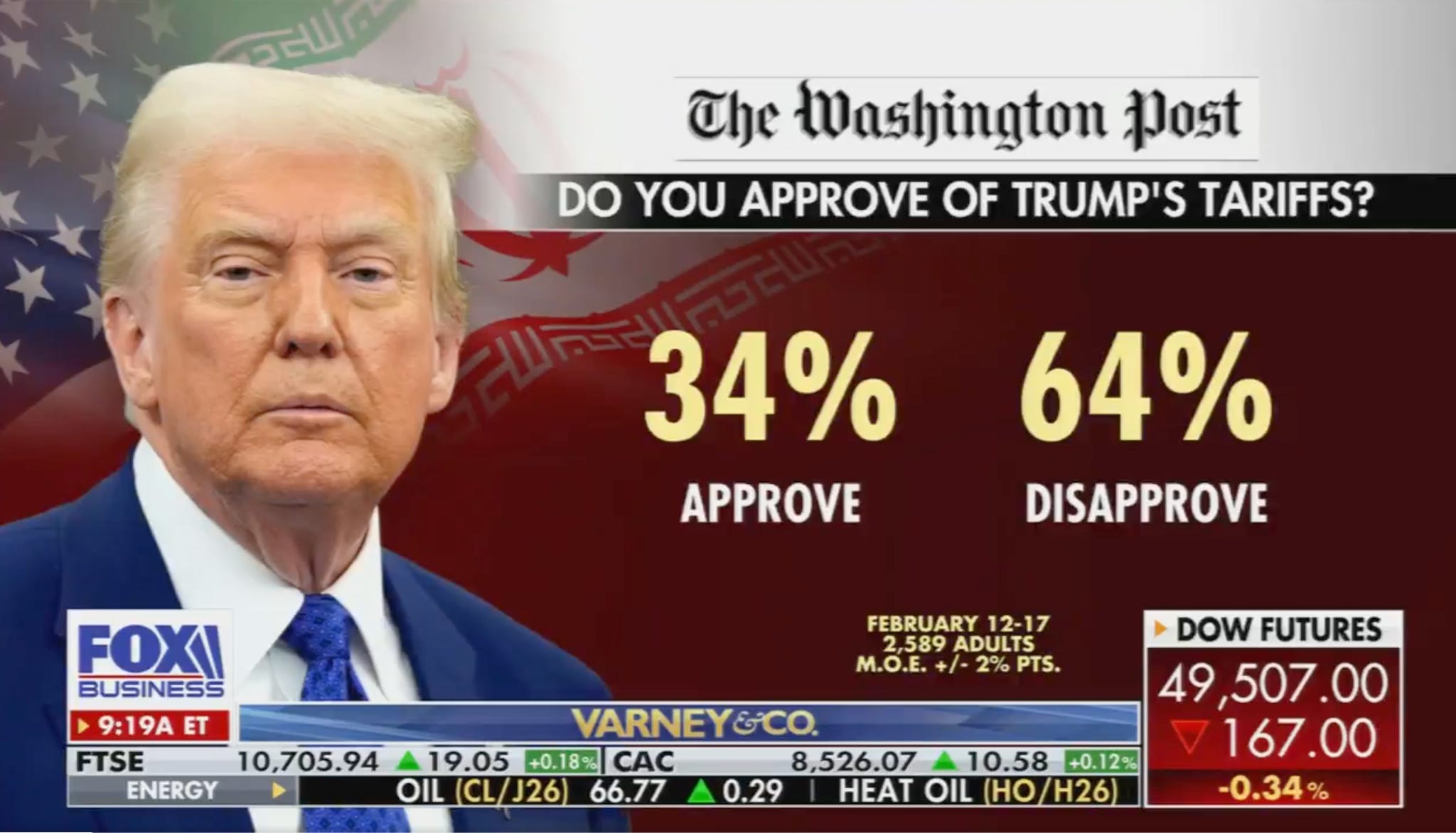
Senate Democratic leaders praised the ruling as a rebuke of executive overreach and emphasized cost impacts for families and small businesses. Governors have gone further: Gov. Gavin Newsom and Gov. JB Pritzker publicly demanded tariff refunds, with Pritzker sending Trump a literal “invoice” framing the tariffs as unlawful costs imposed on families. Even across the aisle, you have Fox Business highlighting that 64% of Americans disapprove of Trump’s tariffs!
Image Credit: X
The logistical play of if tariff refunds can happen are still very much in the air. But regardless, voters will not be parsing through the language to see what avenue the administration is going through next to unleash tariffs. All they need to understand is that much of these were already illegal, paid for by U.S companies and consumers, and Trump wants to find a way to continue to increase those costs.
A disciplined affordability message Democrats can run through November
A durable midterms message needs to be both accurate and repetition-friendly. The Supreme Court opinion helps because it supplies elite validation for plain language: tariffs are taxes and Congress holds the power to tax. A strong Democratic frame:
“Trump tried to raise prices with illegal tariffs. The Supreme Court stopped him—but he’s still trying to keep tariffs in place. Democrats will fight the tariff tax to help lower costs.”
That frame naturally supports concrete deliverables Democrats can point to: stopping or limiting new tariffs through legislation and oversight; or at minimum forcing votes and accountability; and targeted cost relief for the categories voters feel every week, food, household basics, kids’ goods, reinforced by evidence that tariff costs land on domestic consumers.
The Supreme Court just handed Democrats something far more useful than a white paper: a clean, concrete contrast. The affordability message is sitting right in front of them, tariffs are taxes, many were illegal, and families paid the price. Leaders from Wyden to Newsom are already framing it as an illegal tax on groceries and everyday goods. Rather than layering on a sprawling new agenda, Democrats can win by narrowing their promise: stop the tariff chaos, to help lower costs. In a political environment where voters are skeptical of big commitments and wary of price hikes, less is more.