

Working-Class Voters Aren’t Feeling Trump’s "Golden Age"

In the first year of President Donald Trump’s new term, working-class Americans – lower income Americans or those without college degrees – many of whom propelled his 2024 victory – have grown increasingly disillusioned as they grapple with a high cost of living and lackluster economic gains. Recent polling underscores the depth of this frustration: in a January survey, fully half of registered voters said Trump’s policies have made life “less affordable” for most Americans. Likewise, about 40% of voters say Trump’s economic policies have hurt them personally, and only roughly 20% feel they have benefited at all. Such findings are striking, considering Trump campaigned on relieving the financial strain of inflation for everyday families.
Trump’s overall economic approval rating reflects this discontent. Only 36% of Americans now approve of Trump’s handling of the economy, down from 42% when he took office in 2025. Voters’ top concern remains the cost of living, yet many believe Trump is neglecting the economy: roughly 7 in 10 voters (including about half of Republicans) say he isn’t spending enough time focusing on the economy. Instead, they see a president often distracted by other priorities. (Trying to take over Greenland, The new Trump Kennedy Center that must be shut down for two years, a UFC stadium on the White House front lawn…the list goes on.) While Trump boasts about “exploding” growth and claims “Inflation is defeated,” the reality belies the rhetoric – consumer prices continued to rise in recent months (driven by food and rent) and job growth has been sluggish.
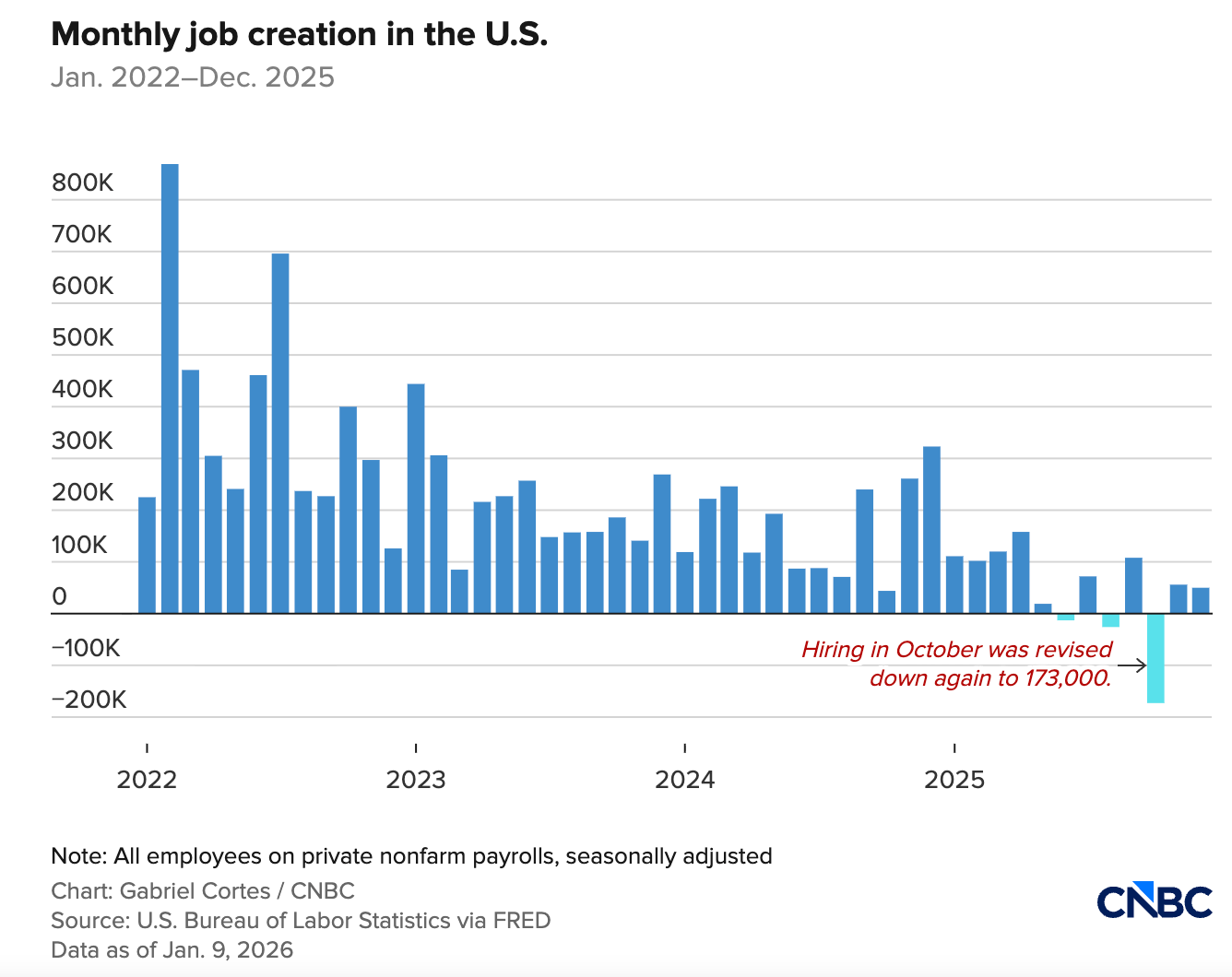
Image Credit: CNBC
Trump’s approval has plummeted across every income bracket, with the sharpest decline among the poorest voters: those same sub-$25k earners now disapprove of him by a net 20 percentage points. It’s a classic case of “last in, first out” the new working-class converts to MAGA are now the first to jump ship.
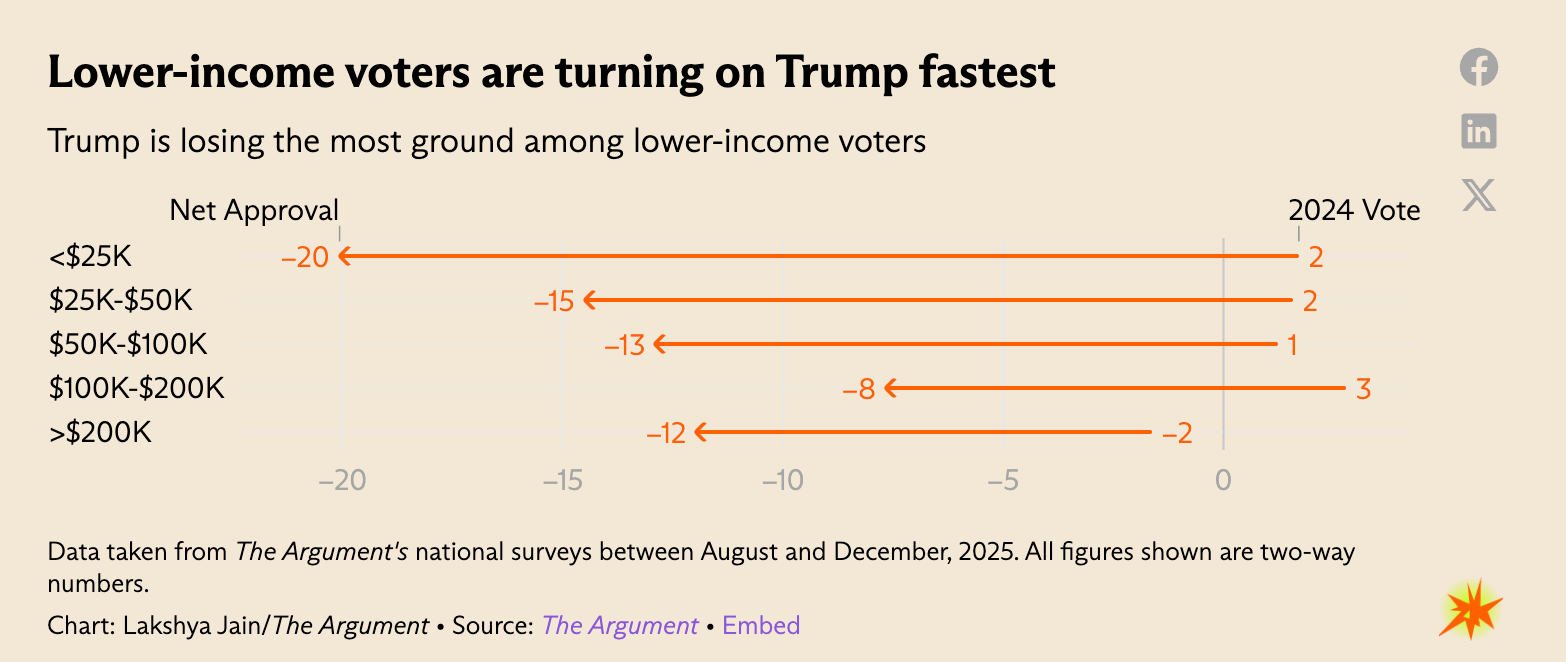
Image Credit: The Argument
Manufacturing Revival That Never Came
A centerpiece of Trump’s 2025 agenda was a pledge to revive American manufacturing and bring back blue-collar jobs. Early in his term, he rolled out aggressive import tariffs – even dubbing April 2, 2025 “Liberation Day” – with the promise of reshuffling trade to favor U.S. factories. Trump touted these tariffs as the linchpin of a new manufacturing boom, aimed at reclaiming industrial “supremacy.” But one year later, those promises have not materialized – in fact, the trend has reversed. Manufacturing employment has been in a steady skid for months, with factories shedding more jobs than they add. The sector lost another 8,000 jobs in December 2025, capping an eight-month downturn that wiped out over 70,000 manufacturing jobs since last spring. U.S. factory payrolls have now fallen to about 12.7 million workers – the lowest level since early 2022, and even lower than much of Trump’s first term in office.
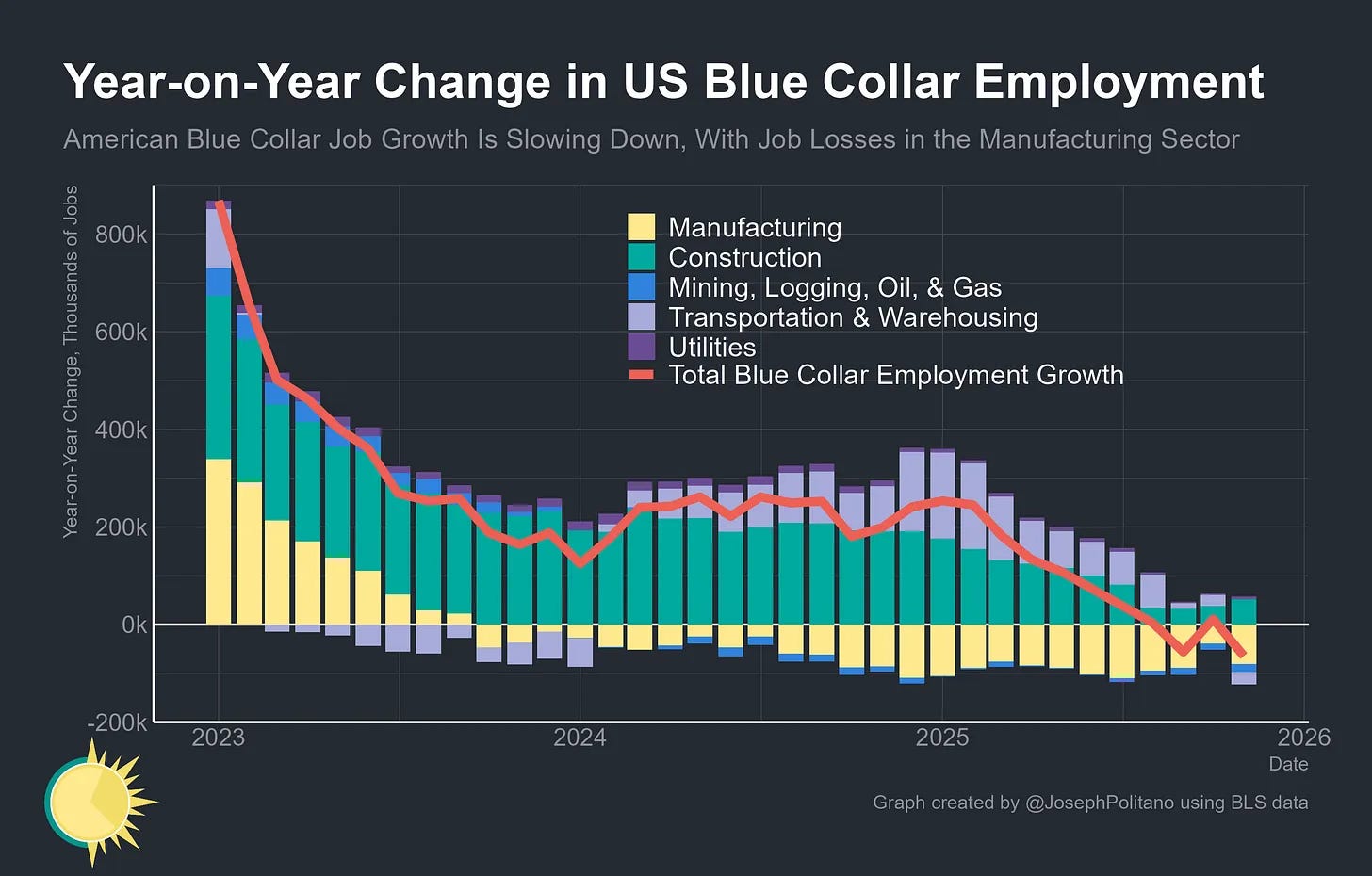
Image Credit: Apricitas Economics
This harsh reality has undercut Trump’s appeal among the very blue-collar communities he courted. Instead of a “blue-collar boom,” working-class households see still-rising prices and an uncertain labor market, feeding a “soured sentiment” about Trump’s economic stewardship. Many manufacturing workers feel the pain directly. By August 2025, 42,000 factory jobs had vanished in the months following Trump’s tariff announcement. CEO of BCI Solutions Inc reported scaling back: “Every time I hear that manufacturing is booming, I scream at the TV,” whose workforce has shrunk to its smallest since the early 1990s. Trump’s trade war was the opposite of a revitalization, costing American households an estimated $2,400 a year in higher prices for consumer goods – an added hit to working families’ wallets. Workers are losing jobs, not gaining them, under Trump’s agenda.
A Midterm Strategy Focused on Costs and Jobs
With Trump’s working-class base showing signs of estrangement, Democrats see a prime opportunity to win back those voters in the 2026 midterms – if they zero in on economic concerns. Recent electoral trends suggest this strategy can work. In the 2025 state elections, Democratic candidates in Virginia and New Jersey ran hard on affordability and jobs – and succeeded in flipping many working-class voters who had leaned Republican in 2024. Polls confirm that a strong economic focus is potent: when voters believe a candidate prioritizes lowering costs and securing jobs, some are willing to switch sides. In Virginia’s governor race, for instance, the economy was the top issue for voters, and the Democrat won a large majority of those who prioritized economic issues.The Center for American Progress noted that these results “suggest that at least some working-class voters remain highly responsive to economic issues”, reassessing their loyalties based on who they perceive as better able to address their concerns. In other words, pocketbook issues still cut through partisan lines. Yet, bizarrely enough many Democrats remained silent when Trump’s tariffs were ripping through American’s wallets. The Center for New Liberalism has been tracking them here.
Democratic leaders are thus positioning the 2026 midterm message squarely on relieving the cost-of-living squeeze and boosting secure employment. They argue that Trump’s struggles – rising prices, declining manufacturing jobs, and policy chaos – amount to broken promises for working families. By contrast, Democrats are vowing to lower everyday costs (from groceries to gas to housing), protect well-paying jobs, and invest in real economic growth that reaches the middle and working class. The data gives them plenty of ammunition: Americans consistently say they want more affordability and feel Trump isn’t delivering. Actually, their wording was more direct, stating that achieving a middle-class life is becoming a “pipe dream.” I, for one, am applauding the switch in rhetoric when it is undoubtedly needed. If the evidence is there to back you up, don’t pull any punches right now.
If Democrats can credibly present solutions, such as removing Trump’s tariffs, boosting domestic supply chains, investing in energy and housing production, and reducing regulatory bottlenecks, they have a chance to rebuild the multiracial working-class coalition that drifted toward Trump in 2024. Indeed, even Trump’s strongest demographic – white voters without college degrees – now shows significant softening in support (around 49% approve vs 51% disapprove in one recent Fox News poll), a stunning decline from the roughly 2-to-1 advantage Trump enjoyed with that group in the last election.
Democrats must keep the spotlight on the wallet issues. Every speech, campaign ad, and policy proposal in the midterm run-up should hammer on lowering costs and securing good jobs. This means highlighting stories of families squeezed by inflation or workers laid off from factories, and then offering plans to help, whether through tax relief, childcare support, cheaper healthcare, or investments in infrastructure and clean energy manufacturing. Democrats can contrast with Trump’s failing record and shifting priorities. Hint: The man who cares more about marble countertops is not the populist savior who cares that you can’t afford healthcare.
Trump’s early economic stumbles have put his 2024 working-class gains at risk. Persistent living costs and unmet job promises are weakening his support where it matters most. Democrats have a real opening, but only if they stay focused on prices (above all), paychecks, and jobs.