

What Elizabeth Warren Gets Wrong About Affordability
We Shouldn’t be Trying to Re-run Bidenomics

You ever see someone describe a set of ideas so poorly that you think they must be either confused or deliberately misrepresenting things. That’s how I felt last week as I was watching Elizabeth Warren’s speech on the future direction of the Democratic Party.
There’s a lot in the first half of the speech that is implicitly arguing against any sort of move to the middle on economics and, more frustratingly, seems to think that the only reason anyone would ever want to do that is to suck up to billionaires. Then she gets into an explicit discussion of Abundance politics saying:
“When this agenda is about making government more effective, count me in. The Consumer Financial Protection Bureau was built in the spirit of “Abundance” before “Abundance” was hip. The agency consolidated scattered authorities and streamlined bureaucratic processes. And best of all, it worked. Every year, the agency rooted out the fraudsters and returned more than a billion dollars to people who had been cheated. The [Consumer Financial Protection Bureau] CFPB should be a poster child for government efficiency.”
She goes to attack Abundance as a kind of Trojan Horse that isn’t motivated by all of the problems associated with scarcity but rather by a desire to flatter billionaires. Reid Hoffman plays a much bigger role in her story than housing. Which is odd because she and Tim Scott were the two lead Senators on the Road to Housing Act. For what it’s worth, I praised her for that and my colleague Tahra Hoops wrote a whole article on how great that bill is. It’s like Warren can work on the details of housing reform but then that has no traction on shifting her broader worldview. She knows she hates billionaires; that’s her North Star. But she’s so unblinkingly focused on that, it leads her into all kinds of mistakes when it comes to how you actually bring down the cost-of-living. Four mistakes in particular stand out, and if Democrats want to get affordability politics right, it is *critical* that we recognize that these four lines of argument are errors, not sound foundational ideas.
1. Open Hostility to Business
2. Zero-Sum Economics
3. Abundance is Somehow “Unambitious”
4. Bidenomics was a Popular Success
Open Hostility to Business
Warren’s speech reveals a fundamental misunderstanding of what the Abundance Agenda is actually about. She praises the CFPB as exemplifying “the spirit of Abundance” because it “consolidated scattered authorities and streamlined bureaucratic processes.” These are fine things, but they have essentially nothing to do with Abundance.
The Abundance Agenda is fundamentally about building more and that will sometimes be government-led projects like mass transit, but building more also necessarily includes making it easier for businesses to build the things people need. Yes, it’s in part about government efficiency but it’s also very much about approving housing construction, greenlighting energy projects, allowing new medical providers to practice, and enabling entrepreneurs to start childcare facilities.
Warren’s version of “Abundance”, by contrast, is all about more enforcement and regulation. Notice what’s completely absent from her speech: any recognition that businesses need to be allowed to actually build things. Housing is the most obvious, though far from the only, demonstration of this. Her one mention of zoning reform is dismissive, saying that it’s something “just for a few policy nerds” (again very strange for a Senator who just successfully worked on housing and for a former Harvard professor to say). The share of housing that is public is tiny. Out of approximately 148 million units of housing in the United States, only about 800,000 of them are public housing. In other words, the overwhelming majority of Americans live in housing that was built by for-profit developers. There are many drivers of NIMBYism, but an important component of it in some blue cities and states is antipathy toward private-sector developers. That has to change.
Instead of embracing business as the primary builders in this country, Warren instead focuses on the FTC as the core of affordability. This is well wide of the mark. The FTC has a role to play when it comes to anticompetitive behavior, but the core driver of affordability is supply and demand and it is businesses that are the providers of supply.
Warren seems to genuinely believe that if we just crack down hard enough on corporate wrongdoing and tax the rich enough, affordability will somehow follow. It’s little more than her same old ideas now just wearing an affordability wig.
It’s also wrong. We have a housing shortage because we’ve made it extremely difficult to build enough housing in areas that deeply need it We have high energy costs because we’ve made it far too difficult to build new energy and new transmission infrastructure (the Trump administration’s attack on clean energy are not helping at all here- this is most certainly not all on Democrats). We have childcare that’s more expensive than it needs to be because some regulations have made it more costly to provide.
Zero-Sum Economics
Warren believes that the most important division in American politics is between the elites and everyone else. This is not an analytically helpful lens for any of the major cost-of-living challenges we face. Massachusetts’ housing scarcity exists because local homeowners, not billionaires, fight seemingly every development. Billionaires are not why it’s so hard to build electricity transmission lines. Childcare costs are high because ratio requirements and facility regulations restrict supply, not because Jeff Bezos is hoarding childcare slots. I know it’s easy and emotionally soothing to blame rich people for these various challenges, but that’s not the path to sound policy choices that will bring down costs.
The problem isn’t just that Warren’s focus on billionaires misdiagnoses the cause and thus offers faulty solutions, it’s that her entire framework traps us in destructive zero-sum thinking. It reinforces the most corrosive idea in American politics today: that we are all locked in a zero-sum fight with each other over scarce resources. Trump, and even more Vance, wants to argue that the cut-line in that fight is between real Americans on one side and immigrants and foreigners on the other. Warren wants to say the cut-line is between rich people and less rich people. The real answer is neither.
A major advantage of a supply focus and a commitment to unleashing abundance is that it gets Democrats and America away from zero-sum thinking. We Americans are not each other’s enemies. We are all on Team America. The enemy is instead a series of invisible graveyards, the things that were never built because regulations blocked them.
The great enemy of the renter is not the developer; it is the invisible graveyard of housing that a developer wanted to build but wasn’t allowed to. The great barrier to climate action and affordability going together is not the everyday person putting gas in their car to get to work; it is the invisible graveyard of green energy projects that should have been built but were stymied. The great cause of long wait times and high costs for patients is not greedy doctors; it is the invisible graveyard of people who could have and should have been medical service providers but weren’t allowed to be. The great foil of affordable childcare is not any conceivable individual or group of Americans; it is the invisible graveyard of childcare and assistance to families that could have been provided but wasn’t.
Abundance is Somehow “Unambitious”
Perhaps the most head-scratching of Warren’s critiques of abundance is that it is unambitious, “nibbling around the edges” as she puts it. There are a lot of ways to describe a political project aimed at:
-Doubling America’s annual housing production
-Making energy so plentiful that it’s dirt cheap
-Lowering healthcare costs
-Making it affordable to raise children
Unambitious isn’t among them.
As best I can tell, because fighting rich people and business is her great white whale, Warren sees everything else as a side quest. But these aren’t side quests; they’re core areas of the American economy and things Americans of all stripes deserve. I can’t imagine a headier, more ambitious project than delivering that.
Yes, of course we support progressive taxation and think Trump’s One Beautiful Bill was terrible. But what exactly is that going to do about our scarcity problem? Warren would argue that her approach (big public investment funded by taxing the rich) is more ambitious. But that misses the point entirely. Public investment matters, but it can’t substitute for the sheer scale of private sector building we need. The government isn’t going to build the millions of homes we need. It’s not going to deploy solar panels at enormous scale or start thousands of new childcare centers. The private sector has to do the bulk of the work, and that requires making it legally and economically viable to do so.
Bidenomics, which should probably be called ‘Warrenomics’, was a Popular Success
Finally, it’s worth dwelling for a minute on the fact that, other than Joe Biden himself, no one has more fingerprints on Bidenomics than Elizabeth Warren. Biden, for all intents and purposes, outsourced much of his economic agenda to Warren and her acolytes. This was widely-discussed at the time. You can find just a few examples of this here (PBS), here (The Boston Globe), here (Mother Jones), here (Bloomberg), and here (Politico).
Given this, it is perhaps not surprising that Biden governed as the most economically left-populist President in half a century. Warren got nearly everything she wanted:
-Huge public spending ✅
-Trade protectionism ✅
-Hostility to business ✅
-Zealously regulatory ✅
-Rhetorically populist ✅
Warren and people of her belief set thought this approach to economic governance was going to be popular. This was going to usher in some new ‘post-neoliberal’ world or something like that. They were positively gleeful that economists held less sway under the Biden administration than they had in the Obama and Clinton administrations. Did this approach, this Warren-authored Bidenomics, produce an economy the American people were happy with? No, obviously not. The inflation it exacerbated made Bidenomics an albatross for Democrats in 2024.
By a two-to-one margin, voters wanted the next President to be a major change from Biden.
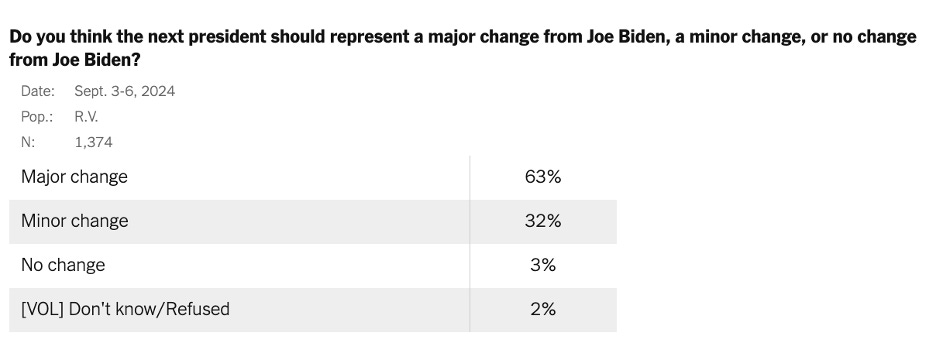
One of the Trump campaign’s most devastating attack ads against Harris was just clips of her saying over the years how much she liked Bidenomics. She couldn’t get away from it.
Newsflash: working and middle class voters HATE inflation because they find it incredibly stressful.
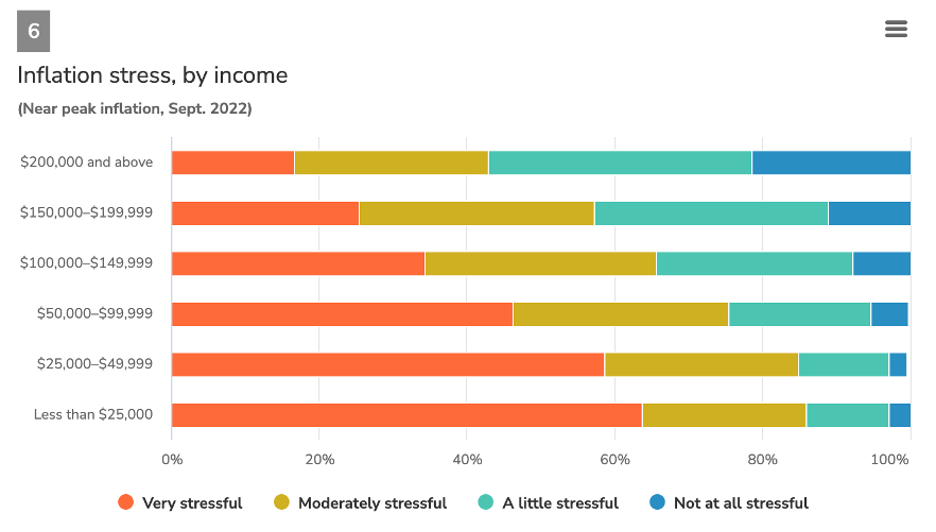
This is likely the single biggest reason that Democrats lost non-college voters in 2024 by 14 points.
As to Warren’s charge that Harris was too moderate, that is decidedly NOT a diagnosis that most voters shared. Only 9% of voters considered Harris “not liberal or progressive enough.” Meanwhile, 60% of voters believe that the overall Democratic Party has gone too far left.
It would be one thing if Warren’s ideas had turned out to be successful and popular. But they weren’t. The most important task before us as Democrats is defeating Trump and Trumpism. We cannot do that if what we are offering the American people is Bidenomics the Sequel. Instead, we can honor progressive values while embracing the supply-side reforms that will actually bring down costs for middle-class families. That synthesis—progressive ends through abundance means—is how Democrats can win and how America can prosper.
-GW
Does anyone have suggestions for how to sway the crowd that hates developers? I grew up in Vermont, and part of Vermont culture is to grow up being taught that developers are bringers of Great Evil To These Lands. It is a deep bigotry that saturates the state.
How do you upend this belief?
Great work from Gary
Warren is advocating the policies of more regulation, red tape, and higher taxes, and slapping an “abundance” label on it to try to appeal to the “abundance” crowd.
As Gary illustrates, these policies don’t work and are, for the most part, fundamentally at odds with the abundance movement.
Sad because all she would need to do is read The Rebuild, Risk & Progress, or another true abundance publication to see where she gets it wrong.