

The Generation That Gave Trump a Shot Is Done Waiting
Many young voters swung right in 2024, now they’re souring fast.

It’s been almost a year since Donald Trump returned to the White House, and America’s youngest generation is feeling more disillusioned than ever. Far from being apathetic, Gen Z (and young Millennials) are under profound strain – grappling with economic instability and a sense that the system is misaligned with their lives. In a recent national poll of 18–29 year-olds, only 13% said the country is headed in the right direction. A recent January 2026 YouGov poll had this same age group registered as 62% disapproval rate of Trump's overall job performance, compared with 55–57% among older generations—indicating that younger voters' dissatisfaction is rising faster than that of the rest of the electorate.“Young Americans are sending a clear message: the systems and institutions meant to support them no longer feel stable, fair, or responsive,” observes pollster John Della Volpe. This generation feels “unheard and unprotected” in a moment of uncertainty – a sentiment that has serious political consequences for President Trump.
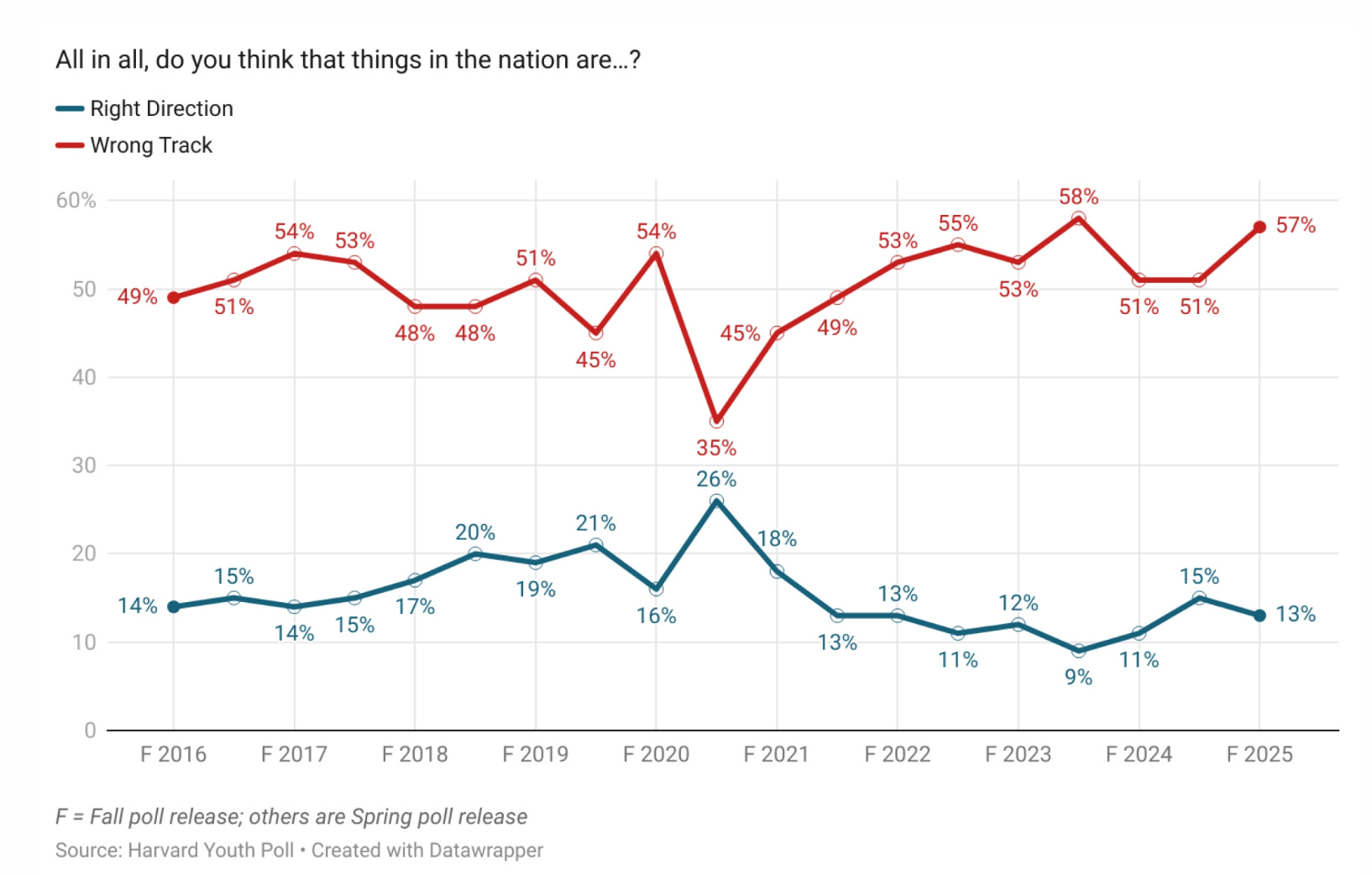
Image Credit: Harvard Youth Poll
Last year, many young voters (including a notable slice of young men) gave Trump the benefit of the doubt, hoping he would “make life easier” by bringing down costs and shaking up Washington. Indeed, Gen Z swung toward Republicans in 2024, helping Trump clinch his comeback. But one year later, those hopes have faded. Opinion polls now show a sharp reversal: youth support for Trump has collapsed, and the very voters who swung right in 2024 are swinging back left. “Groups who moved towards Trump in 2024 – including young voters – are now deserting him and returning to the Democratic fold,” the Guardian reports, citing recent surveys.
Trump’s victory was not proof that young generations are inherently conservative. It was a reaction—a rejection of the prior incumbent and a cost-of-living crisis that made it nearly impossible for many young people to plan for a stable future. One year into this administration, it feels like Trump has responded with a “lol, hold my beer” approach—and dug the hole even deeper. A closer look at the polls reveals that the rift between young voters and this presidency is wider and more durable than he may anticipate, and many will see through these last-ditch grabs at affordability for what they are: election-year panic, not lasting relief.
Young Voters Sour on Trump’s Promises
This pervasive instability has serious political implications. In 2024, Trump shocked observers by substantially improving the GOP’s margins with young voters – especially young men – who were drawn to his anti-establishment bravado and promises to “lower our prices”. Many younger voters, fed up with soaring rents and inflation under the previous administration, decided to give Trump a chance. “I make decent money and I can’t afford a home on the salary I make now,” one 26-year-old told Reuters at a Trump rally, explaining his vote. “It’s time to get a man back into office that is going to lower our prices”. They wanted Trump back because they wanted 2017 prices back. This sentiment – prioritizing economic relief and “America First” pragmatism – helped Trump win about half of young men’s votes in 2024, dramatically better than Republicans had done in years.
But one year later, many of those same young voters are losing patience. The early hope that Trump might rapidly ease the cost-of-living crunch has dimmed. “Trump won Gen Z’s anger. He’s losing their patience,” as Rachel Jafanza put it. Recent polls show Trump’s standing with young Americans has plummeted. In multiple surveys, his approval rating among under-30s hovers only around 30%. (By comparison, at the start of his term it was in the mid-50s among young men.)
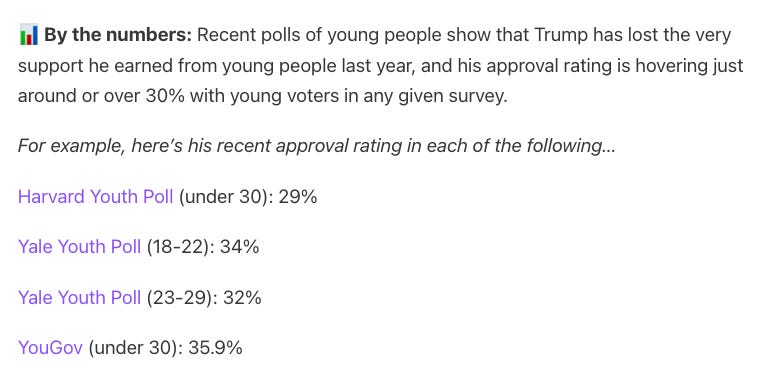
Image Credit: Up and Up
Young women remain the demographic least impressed with Trump. In 2024, they voted overwhelmingly against him—nearly two-thirds of women under 30 backed his opponent—and there is little evidence that this skepticism has softened since.

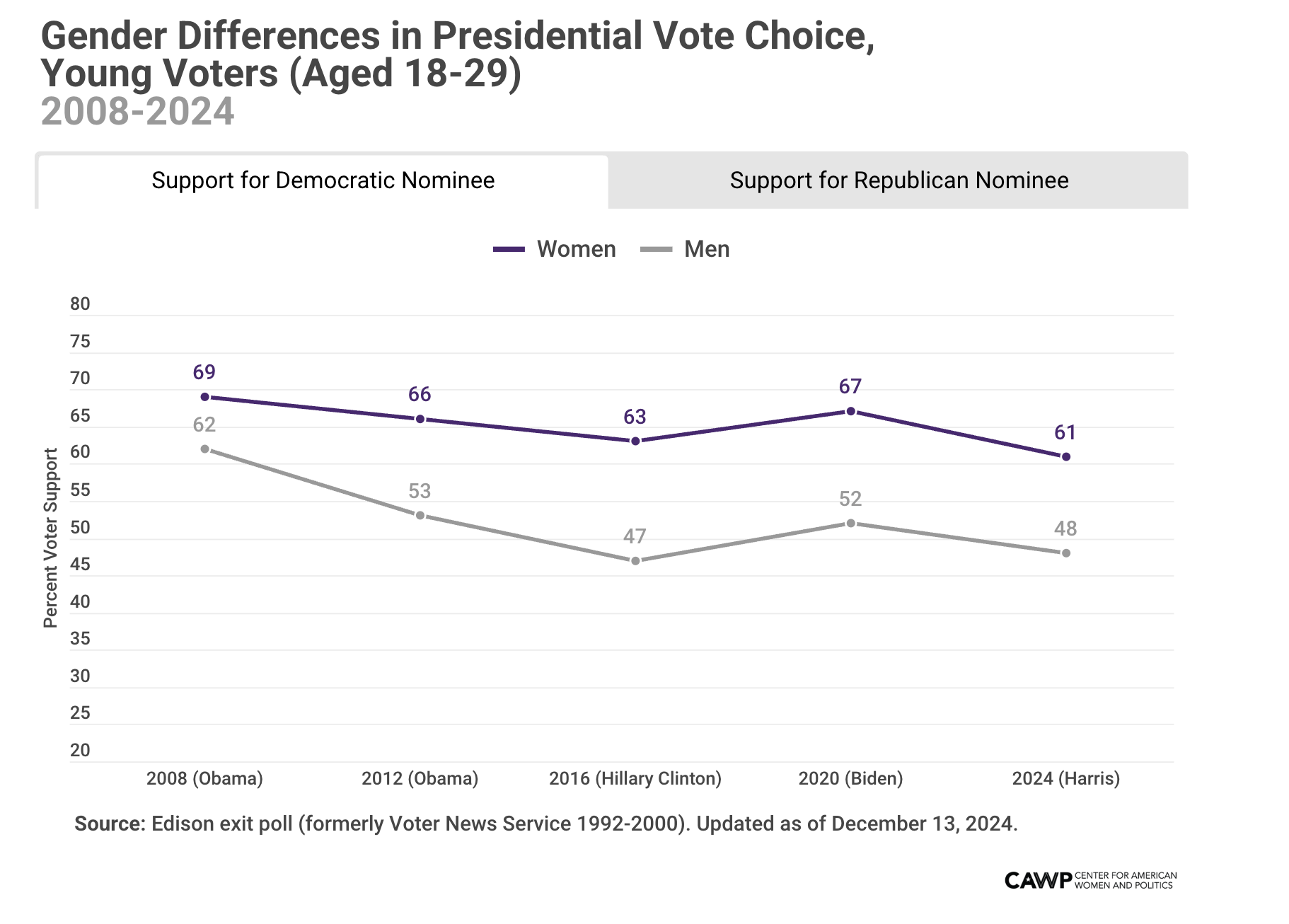
Image Credit: CAWP
For young women, the dominant feeling is being overextended and unsupported – they often anticipate bearing the brunt of crises when systems fail. 70% of young women say the country is on the wrong track, and 65% feel people in power don’t understand “what life is like” for them. Many worry about the costs of future goals: starting a family, childcare, health care, even personal safety – all compounded by economic insecurity, with one respondent stating that she currently feels, “...Responsibility without a safety net.” Without meaningful structural support, this imbalance risks hardening into long-term disengagement, burnout, and distrust in public systems.
Still, even among young men – who were drawn to Trump’s anti-elite, rule-breaking persona last year – there’s a growing sense that he hasn’t delivered. Only 22% of young men now feel Trump is “fighting for people like you,” according to the SAM Project’s large-scale youth survey. In that same study, 57% of young men admitted they often “hold back opinions” out of fear of backlash, reflecting a climate where they feel unheard and constrained. Many of these men originally supported Trump as a rebellious outlet for their frustrations, but soon noticed the agent of change was merely an agent of chaos who has yet to make their daily lives more affordable or easier.
Indeed, “affordability” remains the watchword for Gen Z, and on that front they see little progress. A Republican pollster close to the White House warned that “affordability means housing in every bit of data we’ve seen” from young voters. That is, the cost of housing dominates youth concerns. This isn’t just theoretical – it was young voters concerned about housing prices who in many ways delivered Trump’s 2024 victory, the pollster noted. Now those same young Americans see rents still high and starter homes still out of reach. Annual shelter inflation remains about 3%, and home prices, while cooling from the 2021–22 frenzy, are still elevated after climbing 75% since Trump’s first election. Young voters increasingly see Trump’s presidency as turbulent and self-serving. Many feel he has focused on the wrong priorities – from picking fights abroad to waging personal battles – instead of providing relief at home. For a generation that started out simply seeking stability and affordability, Trump’s chaotic approach has frayed whatever trust they cautiously extended a year ago.
Spaghetti Policies Aimed at Midterms
Inside the White House, Trump appears aware that young Americans are souring on him – and he’s been scrambling to win them back (or at least stop the bleeding) before the 2026 midterm elections. In recent weeks, the administration has floated a series of splashy, last-minute policy moves, which is almost akin to throwing spaghetti at the wall and seeing what sticks – desperate populist measures with questionable follow-through. One example is Trump’s call to cap credit card interest rates at 10% for one year, a proposal announced on social media in early January. “Effective January 20, 2026… a one-year cap on credit card interest rates of 10%,” Trump declared on Truth Social. He framed it as standing up to usurious banks – “we will no longer let the American public be ‘ripped off’ by credit card companies,” he wrote. But notably, Trump provided no details on how he’d enforce this cap, which would almost certainly require an act of Congress. No executive order or legislation accompanied his post, and major credit card issuers have not indicated any voluntary compliance. The time frame is also curious, keeping it only to a year, seemingly enough to keep his approval rating afloat through the midterms. In essence, Trump’s interest-rate cap was a symbolic nod to financially strapped youth, but with midterms looming, it looks more like a campaign ploy than a policy that will tangibly lighten Gen Z’s debt burden.
Another attention-grabbing pledge came when Trump declared he would “ban large institutional investors from buying up single-family homes” Trump’s housing crackdown may sound like a populist swing at Wall Street, but the numbers suggest it’s largely symbolic. As Bloomberg Opinion columnist Conor Sen pointed out, institutional investors—the target of Trump’s proposal—own only a tiny slice of the market. The latest figures show they hold just 0.5% of all single-family homes in the U.S., and around 3.3% of single-family rental units, based on data from Blackstone, AEI, and major operators like Invitation Homes. With over 85 million such homes nationwide, the idea that banning these firms would meaningfully expand housing access is questionable at best.

Image credit: Housing Wire
Sen also argues that eliminating institutional buyers wouldn’t free up inventory—it might backfire, leading homebuilders to cut production due to decreased liquidity and demand. Rather than unlocking more homes for families, Trump’s policy could shrink supply, making it harder, not easier, for Gen Z and other first-time buyers to enter the market.
In the realm of housing, Trump’s team has floated even more unorthodox ideas. One under serious consideration: extending the standard 30-year mortgage to 50 years for first-time buyers. The appeal is clear—smaller monthly payments for cash-strapped young Americans. But as I’ve written previously in Home of the Brave, this is a short-term fix with long-term consequences. A 50-year mortgage would mean paying tens (or hundreds) of thousands more in interest, locking Gen Z into a lifetime of debt just to afford an entry point into the housing market. Such a structure would work against affordability by inflating asset prices and discouraging mobility. It’s a debt trap disguised as opportunity.
Looking Ahead: Drifting to Alternatives
If the past year is any indication, young Americans’ patience for political posturing without results is running out. Far from cementing a new generation of “Trump Democrats” or Republican converts, the president’s first year back in office has driven many young voters to reconsider their loyalties.This isn’t because Gen Z is enamored with the Democratic Party – Rather, young people see the opposition as at least more aligned with their desire for stability, affordability, and avoidance of chaos.
For Trump and his party, the warning signs are flashing red. Gen Z is often described as a disengaged generation, but we are seeing a different story: they are deeply strained, not apathetic. They are paying attention to whether leaders deliver on bread-and-butter issues. And right now, many feel Trump hasn’t delivered – “he talked big” but life is still unaffordable. Gimmicks like one-year rate caps and blame-the-corporate-landlord might grab headlines, but they don’t instill long-term confidence in struggling younger generations who still feel like owning a home may be a pipe dream. One year after returning to power, Trump faces a generational rift that is largely of his own making. As the 2026 midterms approach, young Americans are signaling that if leadership won’t address their reality – the crushing cost of living and economic insecurity – they’ll seek out anyone who will, or at least who won’t make things worse.
Thank you for this well-researched, well-reasoned article. While perhaps the trend of disappointment is more pronounced this election cycle, I have to say, I think this is something that always happens. I particularly remember how a lot of young people became disenchanted with Barack Obama after he failed to come through on certain promises, like ending the war in Iraq, as well as implementing a corporate-friendly healthcare bill and abandoning the public option.
The reality is, no one man is going to swoop in and fix all our problems and this is a realization that comes with age and wisdom. The best thing you can do is vote pragmatically for the best option at a given time.
This should be a wake up call for Dems. Affordability is the number one issue voters care about. Especially Gen Z and millennials. Family formation is a stabilizing force in society and right now young people see the costs of having a family as prohibitive. Big memetic ideas are required. Here's one:
https://open.substack.com/pub/priceofbeans/p/redistributing-opportunity-why-democrats?r=9x3dh&utm_campaign=post&utm_medium=web