

The Energy Vision Democrats Need
Senator Gallego’s Plan is the Way Forward

For too long, Democratic energy policy has been caught in a trap of our own making. We championed climate action, and we were right to do so, but somewhere along the way, our energy politics became associated with limits and saying “No.” We let one faction of our coalition (environmental activist organizations) push the party into an anti-growth posture that was both wrong on the merits and bad politics. It’s an important part of how we lost working-class voters in the communities that extract the resources our modern economy depends on and how we created political vulnerabilities for ourselves on cost-of-living issues.
Energy comprises 6.4 percent of the Consumer Price Index, in other words about 6.4 percent of everything people pay. After housing, healthcare, and food, it’s the next biggest expense in the average household’s budget. When Americans fill up their gas tank, turn up the heat, or turn on the lights, they want that to cost as little as possible. If Democrats are seen as indifferent to these kitchen-table costs, we will lose, and we will deserve to lose. Bringing costs down has to be at the center of everything we do in economic policy.
Meanwhile, the energy landscape is transforming in huge ways. Electricity demand is surging after nearly two decades of stagnation. Between the electricity needed for more AC, more electric vehicles, clean tech manufacturing, data centers, and general economic growth, we’re looking at demand increases of 2-3 percent annually for the foreseeable future. We can either meet that demand with abundant, affordable, all-of-the-above energy policy or we can fail the American people.
And the Republicans aren’t helping. Their assault on the Inflation Reduction Act kneecaps green energy investments that were going to reduce costs, create more manufacturing jobs (particularly in the Sunbelt), and boost American competitiveness. What they’re doing is the opposite of all-of-the-above energy; it’s owning the libs even if that means higher long-term prices.
So where do we go from all that?
Enter Senator Ruben Gallego’s new energy plan, just released this morning. It’s a five-pillar framework that shows Democrats can be the party of climate action AND the party of abundance. It addresses affordability, emerging technology, reliability, and infrastructure, and it does so in ways that represent a smart evolution in Democratic thinking. This isn’t your typical “let’s just phase out fossil fuels and hope for the best” approach. It’s a growth-oriented, worker-friendly, cost-conscious strategy that takes seriously the challenge of meeting rising demand.
More importantly, it represents what a new Democratic energy consensus could look like: one that respects the people who build and extract, that leads with affordability rather than sacrifice, and that recognizes abundant clean energy is the path to both climate progress and electoral success. This is a framework for saying “Yes.” Yes, to more energy, yes, to new technology, yes, to building infrastructure, yes, to good jobs, and yes, to lower costs for families.
Affordability: the Core of Supply-Side Climate Policy
Gallego’s approach starts by reinstating two key tax cuts that Trump’s One Big Beautiful Bill (BBB) eliminated:
- The Residential Clean Energy Credit, which provided a 30 percent credit for solar panels, wind turbines, heat pumps, and battery storage that helped over 1.2 million households in 2023.
-The Energy Efficient Home Improvement Credit, which provided a 30 percent credit for air conditioners, water heaters, windows, doors, and insulation that helped over 2 million households in 2023.
These credits cut Americans’ taxes, put money back in their pockets, reduced long-term utility bills for everyone, and supported emerging clean energy technologies. The Trump administration cut these out of culture war spite; reintroducing is a great place for Democrats to start.
But the plan goes further. It recognizes that solar and wind are now among the most affordable energy sources available and couples these tax cuts with major investments in battery storage capacity. The plan also streamlines federal permitting by setting clear application timelines, expanding categorical exclusions for low-disturbance projects (which means that green energy projects do not have to go through mountains of extra paperwork to prove that they’re good for the environment), and creating streamlined processes for energy projects on brownfields.
Previous Democratic energy policy too often led with environmental benefits and treated affordability as a secondary concern as something we’d address through subsidies for the poor rather than by fundamentally bringing down costs. Gallego’s approach helpfully inverts that priority structure. It leads with lower bills and recognizes that more supply means lower prices. It understands that permitting reform means faster approval which means cheaper projects which means more accessible clean energy. The consumer comes first and the climate benefits follow naturally from abundant energy.
Innovation: Because Technological Progress is How Things Get Better
America is in a global race for energy technology leadership, and we’re at risk of losing. China just approved ten new nuclear power units while we debate whether to support our own nuclear industry. Gallego’s plan addresses this by making a substantial commitment to funding research and development for small-module reactors (SMRs) and other advanced nuclear projects, including creative collaborations between the Department of Energy and Department of Defense for deployment on military installations and national laboratories. As far as the Nuclear Regulatory Commission (NRC), it builds on the ADVANCE Act, which Congress passed last year. Gallego’s approach helpfully treats nuclear not as something to grudgingly accept but as a progressive priority for reliable, carbon-free baseload power.
His plan also supports geothermal development by streamlining permitting for exploration and reinstates the clean energy investment tax credits that Trump’s OBBB killed such as the Clean Electricity Investment Tax Credit (48E), Advanced Energy Project Credit (48C), and the Advanced Manufacturing Production Tax Credit (45X). It also preserves the transferability provisions that are particularly helpful for small businesses by allowing them to sell their credits to larger firms for immediate cash rather than being shut out due to short-term insufficient tax liability. The government has a crucial role in backing innovation that the private sector can’t risk alone, especially for first-of-kind projects with high capital costs (which is exactly what projects like cutting edge small module nuclear reactors and new energy technology are). Restoring these credits is about doing exactly that.
For too long, Democratic energy policy emphasized what we needed to phase out rather than what we should build. It was a politics of subtraction, not addition. This flips that. It’s an investment mindset focused on what comes next: SMRs, geothermal, advanced battery storage, etc.
Reliability: Because the Power Going Out is Bad!
It sometimes gets lost in the political conversation, but arguably the most important aspect of electricity is that it gets delivered reliably. Gallego’s plan invests in greater baseload power and battery storage for wind, solar, and hydroelectric power while also emphasizing that we can’t have rushed phase-outs that sacrifice reliability for speed, and so, it also calls for ensuring reliable oil and gas supplies. The grid was already less than optimally reliable before the demand increases we’re seeing; his plan addresses both that and the increasing demand from AI and data centers and funding energy cyber security initiatives.
Previous Democratic approaches sometimes treated growing energy demand as a problem to be solved through conservation and efficiency rather than as a reality to be met with expanded supply. This plan, by contrast, embraces demand growth while also recognizing that reliability is a political necessity because voters will punish any party that can’t keep the lights on.
Not Leaving Anyone Behind
There are two different kinds of Americans that we want to be sure to not leave behind in our energy policy: energy-producing communities and disadvantaged communities. Gallego’s plan helps both.
As the plan points out, 64 million Americans live in communities that have historically depended on oil, gas, and coal industries for jobs and revenue. At the same time, clean energy is expected to create 84 percent of new electricity generation jobs by 2030. It’s vital that we help workers in energy-producing have the skills to be able to get these new jobs. The same goes for infrastructure. New nuclear plants could be 35 percent cheaper to build if they repurpose retired coal plants. Alongside solar and wind creating new revenue streams for farmers. This is why Gallego’s plan highlights the need for job training and transition programs.
“The people who work in resource extraction deserve our thanks. When they cut down trees, that timber turns into houses. When they pull natural gas from the ground, that turns into heat and electricity for our homes. When they pull fish from the ocean, that turns into dinner on the table. When they raise cattle, that’s steak for the grill. When they descend into mines and come back with precious metals, that’s the guts of our modern economy. These people- the lumberjacks and the drillers, the fishermen and the cattlemen, the farmers and the miners, these Americans- they are awesome! We owe them a great deal.”
To help disadvantaged communities, Gallego’s plan prioritizes full funding for the Low Income Home Energy Assistance Program (LIHEAP), which in 2023 provided heating assistance to 5 million households, crisis assistance to 1.4 million, and cooling assistance to nearly another million. This is in direct contrast to what the Trump administration has done. Earlier this year, they eliminated all LIHEAP staff, stranding millions of unallocated dollars and leaving millions of families exposed to potential utility shutoffs when it’s freezing. It’s unconscionable. Gallego’s plan reverses that. This is something that should unite all Democrats.
Infrastructure: Energy Has to Be Able to Move
To maintain reliability and keep costs low, the national transmission system needs to at least double in size by 2050. As I explained back in June, we are nowhere close to that and getting worse. In 2023, there were 2,600 gigawatts of generation and storage capacity actively seeking grid interconnection, which more than the capacity of the entire U.S. grid at the time. Every year, more and more energy potential is stuck waiting to be connected than the previous year. This bottleneck in grid connection creates massive uncertainty and makes energy development far more challenging than it needs to be.
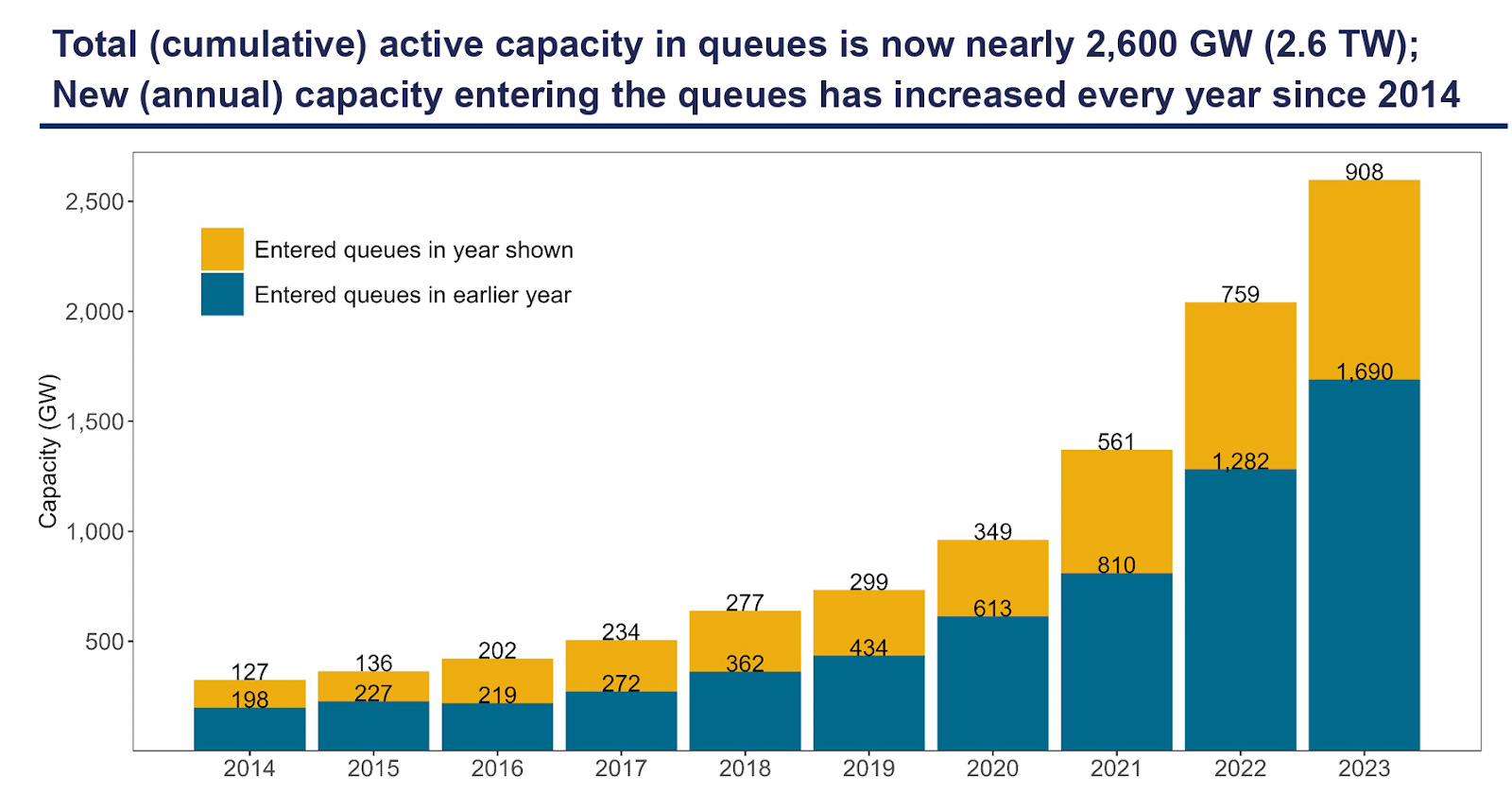
Gallego’s plan streamlines transmission timelines by improving interagency communication for large-scale permits, creating more project ownership within the lead agency, and enhancing coordination between states, private entities, and federal agencies. It uses existing rights-of-way when possible so that multiple components are located in the same place, which helps avoid new siting requirements. The plan also expands categorical exclusions to NEPA for the development of electric transmission within recently approved rights-of-way corridors, for upgrades to existing infrastructure within existing rights-of-way, and for the deployment of batteries or other energy storage on previously disturbed or developed land. All of this is great as policy!
It’s also great as politics. For too many Democrats for too long, “environmentalism” became synonymous with blocking projects. Environmental groups have opposed transmission lines across the country (such as in Virginia last year and Maine this year), even though these lines are essential for moving renewable energy from where it’s generated to where it’s needed. This plan says very clearly: WE ARE PRO-BUILDING. You can’t have abundant clean energy without the transmission infrastructure to move it around. This represents a fundamental shift from a party that often seemed more comfortable saying “no” to a party that knows how to say “yes” to making America a country that builds again.
The Politics of Addition
The beauty of Gallego’s framework is that it’s a politics of addition. Climate progressives get massive emissions reductions through investment in next-generation technology and abundant clean energy. Moderates and swing voters get lower energy bills and greater reliability through tax credits and supply expansion. Rural and energy communities get real transition support rather than being told sottovoce that they’re the ones who need to eat the cost of climate action.
This is why previous Democratic energy approaches failed. They emphasized sacrifice over abundance. They let environmental groups have effective veto power over projects. Their anti-growth aesthetics alienated workers in resource extraction industries. They seemed to respect protesters more than builders. And they underweighted the single most important factor for most voters: affordability.
Gallego’s plan fixes all of that. It treats growth as essential to climate progress. It’s relentlessly pro-worker. And it shows respect for all Americans, including those who do the drilling and the mining that the rest of us rely on. And most importantly, it leads with lower costs as the headline benefit. More energy means cheaper energy, and that’s better for all Americans. Democrats need to get on-board this train.
-GW
This is just hilariously bad analysis. I barely know where to begin, but perhaps one might note that *reinstating elements of IRA that Republicans killed* is not some bold break from previous Democratic policy, it quite literally IS previous Democratic policy! You've just dragged a bunch of right-wing stereotypes about environmentalism into a context where they are visibly, comically out of place.
You're saying we have to get away from the ways Dems have been doing policy and pointing to proposals that simply reinstate Biden-era Dem policy. What?