

Let Foreign Doctors Take Care of Americans
This is the Immigration Terrain Democrats Should Fight On

America doesn’t have enough doctors. The numbers on this are stark: projections suggest we’ll be short up to 86,000 physicians by 2036. Rural areas are getting hit the hardest, but the problem isn’t limited to those places. Thanks to the 1997 congressional cap on Medicare-funded residencies (which we discussed back in October), fast-growing areas are struggling with this too. As the population has boomed in places like Austin or Phoenix, there’s no automatic mechanism to train more doctors to serve those new residents. The cap means that even as demand surges, supply stays artificially constrained. Because of this policy failure (among other reasons like restrictive scope-of-practice, certificate-of-need laws, and physician burnout), patients are experiencing longer wait times, reduced access to specialists, and higher costs when they finally do get care.
A Breakthrough: States Let Foreign Doctors Practice
Until recently, state licensure laws made it impossible for doctors trained and licensed abroad to practice in the United States. This is internationally unusual. Canada, Australia, and the European Union are happy to let qualified doctors immigrate and provide needed medical services.
But then, in 2023, Tennessee became the first state to allow qualified, experienced doctors from abroad to practice in their state subject to passing the same standardized testing as U.S. medical school graduates and practicing under the supervision of a Tennessee-licensed physician for two years. Applicants must be certified by the Educational Commission for Foreign Medical Graduates, pass the same U.S. medical licensing exams as everyone else, have completed at least a three-year residency in their home country, and have recent clinical experience. After that supervision period, they can get a full license to practice independently.
This policy idea spread rapidly. 18 states have now enacted similar laws with 11 others considering legislation. On top of this being good news on the merits, this issue thankfully doesn’t seem to have a partisan split. As you can see, the states that have passed or are considering this policy include red states, blue states, and are in every region of the country.
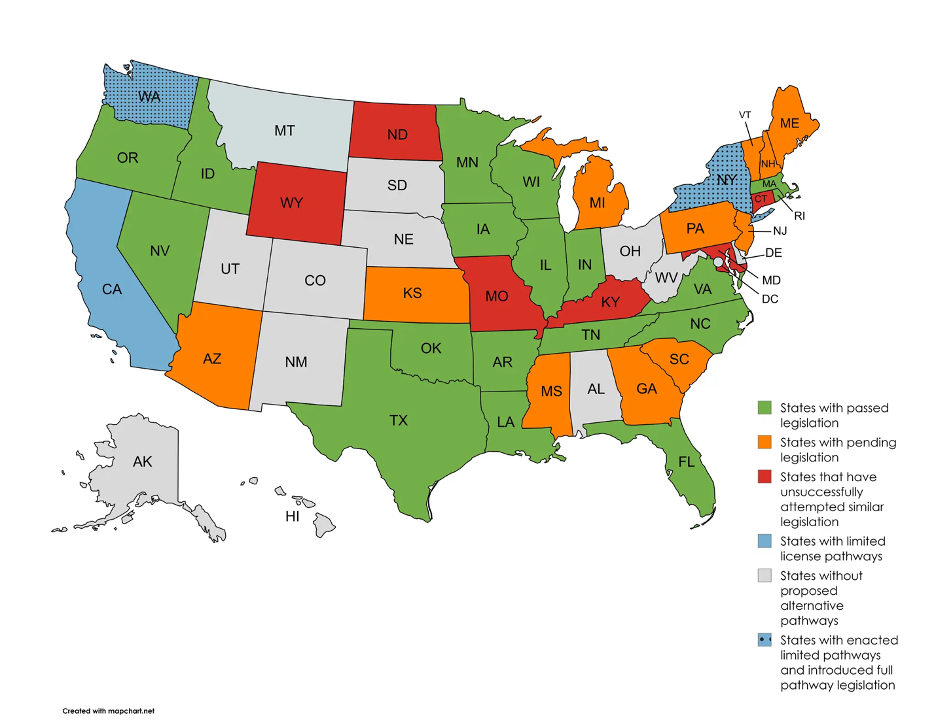
The basic logic makes sense. If a doctor is well-trained and qualified and currently practices in Montreal but wants to move to Maine, it isn’t clear why they would suddenly become unqualified to treat patients? If someone has already trained as a doctor, practiced medicine for years, can pass our licensing exams, and wants to take care of Americans, why would we say ‘no’?
The Benefits
The most obvious benefit is simple supply and demand. When you artificially restrict the supply of anything, you drive up costs for everyone who needs it. These state reforms add qualified providers to the market, which should ease pressure on an overstretched system. But there’s also a massive efficiency gain here. Research shows that up to 40% of immigrants with medical degrees work in jobs that don’t require those credentials. We’re talking about experienced physicians working retail or doing administrative tasks well below what they could be doing. This is a total waste of years of specialized training because our licensing system won’t recognize their qualifications. That’s not just bad for them; it’s a squandered opportunity for us.
The access story is particularly compelling for rural and underserved communities. Foreign-trained doctors have historically been more likely to practice in these areas than U.S. medical graduates. When you’re a small-town clinic struggling to recruit physicians, you need every option you can get. And in fact, some of the state laws specifically require or incentivize practice in health professional shortage areas and so directly target the communities hit hardest by the doctor shortage.
It is also worth noting that other countries have been doing this for decades without quality control problems. Canada and the UK both run similar provisional licensing programs for internationally-trained doctors and there’s no evidence that it has been a problem for them. It cannot be emphasized enough that this is not some risky leap-in-the-dark, it is a policy innovation that our peer countries have used for a long time and that has a solid track record.
How Federal Policy Reform Can Help
These state reforms are great, but federal policy still creates unnecessary obstacles. Foreign-trained doctors need federal work visas to practice in the United States, and the current system wasn’t designed with programs like Tennessee’s in mind. The H-1B visa program for skilled workers, which many foreign doctors use, is subject to annual caps and lottery systems that make planning difficult for both the physicians and the hospitals trying to hire them. The Conrad 30 waiver program, which allows foreign doctors to stay in the U.S. after residency if they work in underserved areas, is capped at just 30 physicians per state per year—a number that made little to no sense when the program was created and makes even less sense now.
Congress should expand these programs to match what states are trying to accomplish. If clinics and hospitals in Wisconsin want to bring in 100 qualified foreign doctors to serve rural communities, federal visa policy shouldn’t be the bottleneck. The state reforms show there’s demand for this talent and that we can credential foreign doctors safely. What we need now is federal immigration policy that enables rather than constrains these efforts.
This is the Immigration Terrain Democrats Should Fight On
Immigration debates often put Democrats on the defensive, where we get stuck arguing about the asylum process, border security, and humanitarian obligations. Those conversations matter, and the Trump administration’s obviously too-aggressive overreach with regards to ICE needs to be stridently opposed, but the fact remains that immigration is not, generally speaking, an issue where the public has a lot of trust in Democrats; one poll from last May found voters trusting Republicans over Democrats on immigration by a margin of nearly two-to-one. On this issue, we need to fight on advantageous terrain and avoid un-strategically charging up every hill. This is that terrain. Foreign-trained doctors have skills we need, arrive here legally, will provide badly needed services for everyday Americans, and are net contributors to the social safety net.
The tangibility helps here. Voters immediately understand that letting these immigrants in means that they will have a greater ability to get their kid into a same-day appointment when they’re sick, see a specialist without waiting months, or help their elderly parents find a primary care provider who is actually accepting new patients. So it’s not surprising that this kind of immigration is very popular. When asked about high-skilled immigrants increasing the number of doctors and nurses in their community, 74% of Americans consider that a positive, versus only 6% who think it would be negative. That is remarkably lopsided for anything to do with immigration.
And this is just one example. The same logic applies to engineers, teachers, researchers, and every other kind of skilled professional who wants to build a life here and has talents that we need. This is the basic story of immigration. It has always made America stronger. America’s message should be “We want people who make things, heal people, build things, teach kids, and start businesses; if that’s you, we want you on our team.”
-GW
My mother’s oncologist was from India. She helped make dealing with the cancer a lot easier for both of us with her patience and compassion.
We need to get rid of the cap so we can start filling all the empty slots and make it easier for people to deal with traumatic life changing events.
I agree with this. Although, I suspect that not all foreign medical education systems are equal. So, there would need to be some vetting. One of the criticisms I often hear is the effect of the “ brain drain” on countries from which the doctors emigrate from which presumably also subsidized their education. Can you address?