

Democrats Are Finally Building…
But Some are Also Sabotaging It

Democrats are in the middle of a supply-side turn and at risk of blowing it. Across the country, Democratic governors used their 2026 State of the State addresses and recent executive orders to lay out exactly the agenda readers of The Rebuild will recognize: faster permitting, environmental review reform, nuclear power, and housing supply. But at the same time, Democrats in Congress are pushing investor bans that shrink the housing stock and multitrillion-dollar tax cuts that drain the fiscal capacity to actually build anything. One wing of the party is expanding supply. The other is doing slopulism. This piece is about both — because if the second wing eats the gains of the first, voters aren’t going to parse the difference. They’re going to notice whether they can afford rent.
The Lightning Plan
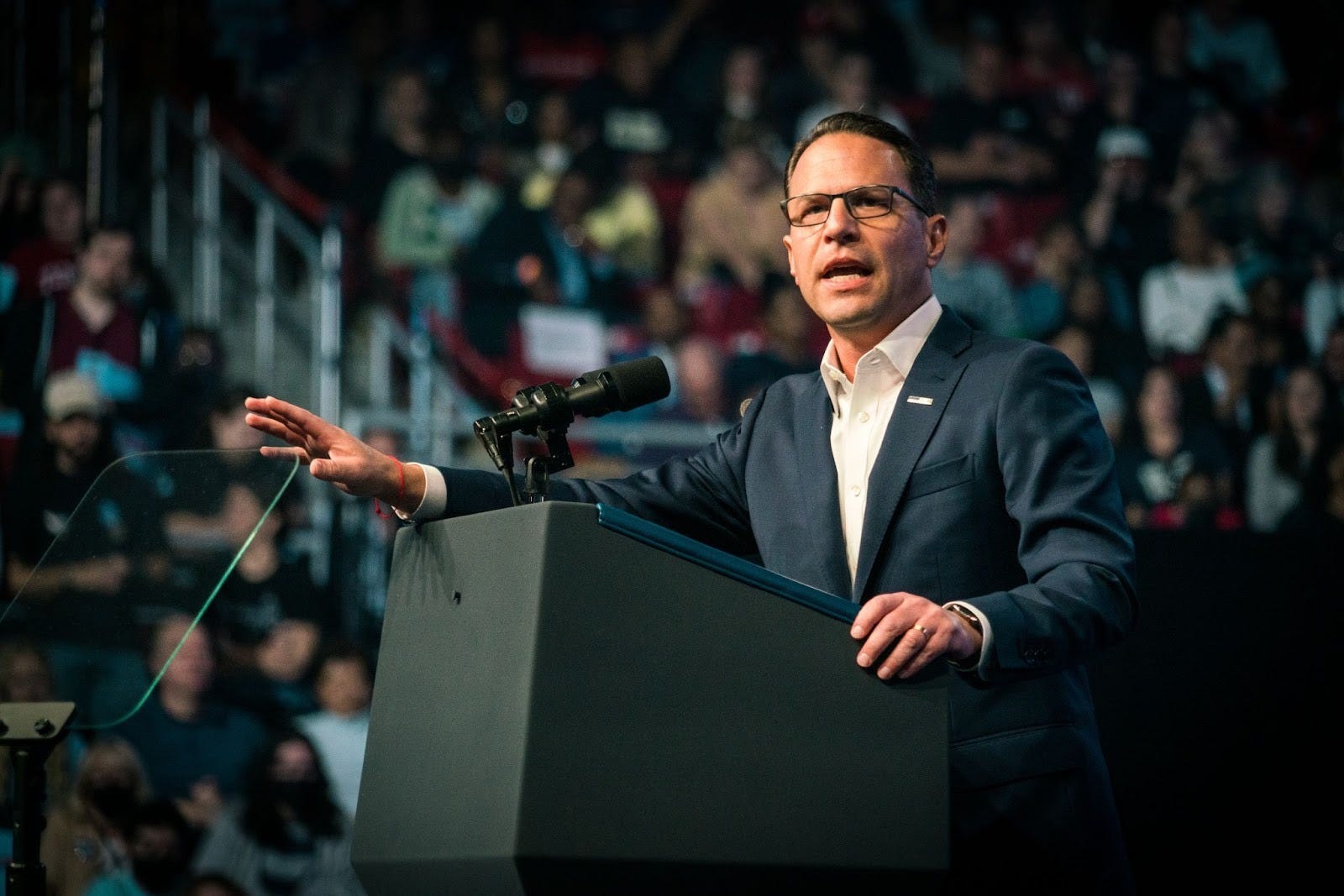
Pennsylvania’s Josh Shapiro has been pushing his “Lightning Plan” to speed up energy permitting, including nuclear, and modernize the state’s energy standards. He also co-chaired the bipartisan NGA Governors Energy and Infrastructure Working Group alongside Oklahoma’s Kevin Stitt, which issued formal recommendations for NEPA reform, nuclear regulatory streamlining, and interstate energy transmission fixes.
He paired the Lightning Plan with a wider economic program focused on lowering costs and accelerating growth: a roughly $1 billion housing and infrastructure initiative to spur new development, increased education funding and workforce training, expanded public-safety investments, and new economic-development incentives designed to attract manufacturing and emerging industries to the state.
Shapiro framed it simply: permitting delays raises costs. Faster permitting lowers them. That’s a message that works in the Lehigh Valley and the Philly suburbs alike.
Hochul: “Let Them Build”
Governor Kathy Hochul made SEQRA reform, New York’s environmental review law, similar to California’s California Environmental Quality Act (CEQA), a core part of her State of the State address.
She proposed exempting housing projects with no significant environmental impact from state environmental review, establishing hard deadlines for review timelines, and fast-tracking infrastructure like clean water systems, parks, and child care centers.
Here’s the stat that should make everyone angry: it takes 56% longer to build a project in New York than in peer states. A review of over a thousand housing projects found that virtually none had significant environmental impacts but they all still went through the full review gauntlet. That’s years of delay and hundreds of thousands of dollars per project for zero environmental benefit.
As Hochul said, “When communities say yes to housing, infrastructure, or clean energy, we’re going to let them build.” NYC Mayor Zohran Mamdani, the state Association of Counties, the Conference of Mayors, and the Association of Towns all backed the proposal. That’s not nothing. That’s a statewide coalition for building.
Hochul also went big on the cost of raising children. She proposed a $1.7 billion increase in child care funding, bringing New York’s total investment to $4.5 billion, with the goal of delivering universal child care for all kids under five. In partnership with NYC Mayor Mamdani, she’s launching free child care for two-year-olds in the city. The logic is straightforward: when parents can’t find child care they can afford, they drop out of the labor force, mostly women. That shrinks the workforce, tightens labor markets, and drives up costs everywhere else. If the moral framework is not enough, it’s worth it to address the economic one.
Pritzker Goes Nuclear
We are in a massive energy supply crisis. It does not help that the President decided to hit the “Make Gas More Expensive” button with his ongoing war with Iran, creating a massive supply shock. Data centers, electrification, manufacturing reshoring demand is surging and the grid is not ready. Nuclear has to be part of an all-of-the-above strategy, and Pritzker just put Illinois at the front of the line.
In Illinois, Governor J.B. Pritzker signed an executive order on the same day as his State of the State directing the Illinois Power Agency and Commerce Commission to issue a notice of intent to developers of new nuclear power plants. The target: at least 2 gigawatts of new nuclear capacity — enough to power roughly two million homes.
He has already instructed his state to begin procurement. Even Republican legislators praised it. “The only way we can possibly expect to have plenty of affordable, reliable baseload power without a carbon footprint is through nuclear power,” said Rep. Jeff Keicher.
When Democrats and Republicans in Springfield agree, take note.
Whitmer: First-in-the-Nation Nuclear Restart
Michigan’s Gretchen Whitmer also used her final State of the State to highlight the first nuclear power plant restart in American history. Her administration secured $300 million in state funding and backed the $1.52 billion federal loan package to bring 800 megawatts back online, powering 800,000 homes.
On housing, Whitmer was just as aggressive. Her administration set a goal of 75,000 new homes per year, blew past it to 86,000, and is now targeting 115,000 — closing the state’s housing gap by 44%. She pushed zoning and building code reform — making it easier to build in-law suites and multifamily homes, modernizing lot sizes, setback rules, and parking requirements. And she made a point that gets to the heart of the supply problem: Michigan’s laws have made it easy to expand suburbs but hard to build walkable downtowns and main streets.
In both housing and energy, Whitmer’s message was the same: if you want more supply, you have to make it easier to build.
Newsom: CEQA Reform, Finally
In California, the CEQA reform package that Governor Newsom signed last year is now taking effect — the most consequential environmental review overhaul in the state’s history. It creates infill CEQA exemptions, streamlines housing permitting through the Permit Streamlining Act, limits Coastal Commission housing appeals, and freezes new residential building standards through 2031. In his State of the State, Newsom reported $109 billion in infrastructure projects currently underway, more than 28,000 projects, under California’s new fast-track permitting authority.
Meanwhile, a California ballot initiative, the Building an Affordable California Act, would go even further: 30-day completeness determinations, strict CEQA timelines, and shortened public comment periods for essential projects.
Lamont: Supply-Side on Energy and Housing
Connecticut’s Ned Lamont used his address to talk about what so many governors avoid: the relationship between supply and costs. “As a business guy I get the power of supply and demand, which impacts costs from housing to energy,” he said. He noted that many states had unplugged nuclear power and plugged in data centers, driving up prices nationwide. On housing, he pushed permitting reform to convert underused parking lots, empty mills, and half-empty malls into homes for nurses, teachers, and firefighters.
Moore: No and Slow to Yes and Now
Maryland’s Wes Moore has been leading on energy permitting reform alongside Shapiro. “When it comes to energy infrastructure, we need to move from no and slow, to yes and now,” Moore said. He also led a bipartisan coalition of governors to the White House to sign a Statement of Principles calling for energy reform, and has been fighting PJM on energy price caps to protect ratepayers.
Moore also went after housing and transit. He rejected approaches that try to limit prices without building more supply, and introduced the Maryland Transit and Housing Opportunity Act, which does what the name says, build more housing near transit and invest in transportation that connects people to jobs. His framing echoed the same supply logic as the energy plan: you don’t lower costs by capping prices. You lower costs by building more.
The Pattern
Take a step back and look at what’s happening:
Pennsylvania is streamlining energy permitting with bipartisan backing
New York is reforming SEQRA to build housing faster
California reformed CEQA and is fast-tracking 28,000+ projects
Illinois is issuing procurement notices for 2 GW of new nuclear
Michigan restarted a nuclear plant — a national first
Connecticut is talking supply and demand on housing and energy
Maryland is pushing federal permitting reform while capping energy prices
Governors who are building things, permitting things, and powering things and doing it while cutting costs for families.
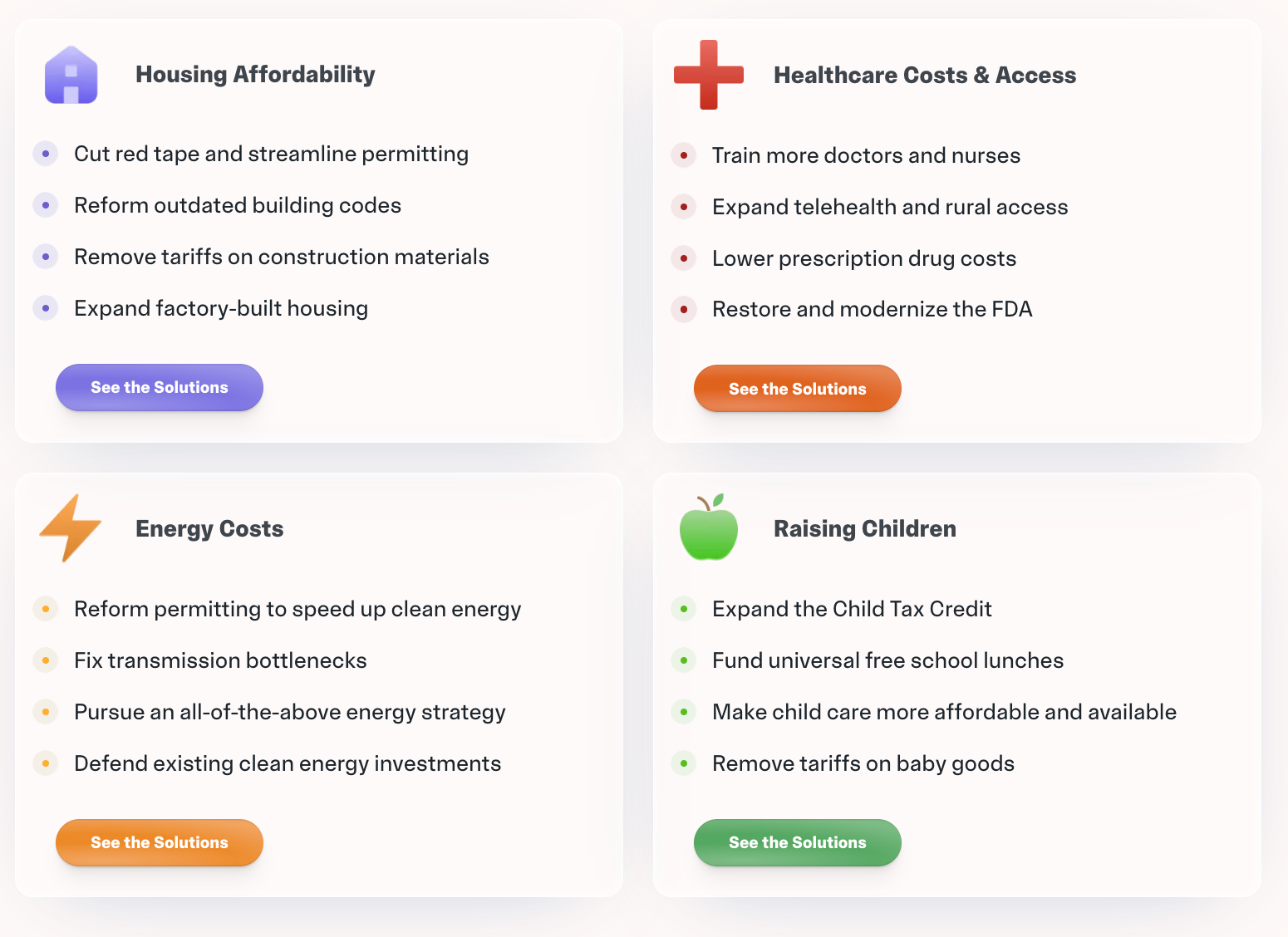
A lot of the ideas highlighted here and more can also be found in our new Cost of Living Blueprint. You can read that here.
Don’t Let Slopulism Eat the Gains
For all of the great movements we have been seeing, I have also seen us take steps back when we look at Democrats as a whole. Here’s where I get nervous.
The same week these governors are laying out a supply-side vision, Congress passed the 21st Century ROAD to Housing Act, which includes a ban on institutional investors purchasing single-family homes — with a seven-year forced divestiture requirement for build-to-rent housing.
The investor ban is a problem. Large institutional investors own roughly 3% of single-family rentals nationally 1.4% of the total single-family housing stock. Their purchases amount to less than 1% of annual home sales increase the owner-occupied supply by no more than 1-2%. Worse, the seven-year forced sale requirement on build-to-rent homes threatens to eliminate a category of new construction that now accounts for 3-10% of new single-family home starts. That’s a supply-side housing bill with an anti-supply provision bolted onto it.
This is slopulism in action: a policy that feels like standing up to Wall Street while actually reducing the supply of homes available to lower- and middle-income renters. The average single-family renter served by institutional landlords has a credit score of 650 and a household income of $88,000 — well below the average homeowner. Many of these renters can’t qualify for a mortgage. Banning their housing provider doesn’t give them a mortgage. It gives them fewer options.
Democrats should support the ROAD Act’s supply-side provisions; but the investor ban is the equivalent of putting a toll booth on a new highway. It undermines the very goal the bill is supposed to achieve.
And the slopulism doesn’t stop at housing. Sens. Cory Booker and Chris Van Hollen just unveiled plans to eliminate federal income taxes for tens of millions of Americans — Booker’s version alone would cost $5.5 trillion over ten years — funded entirely by taxing the super rich. It sounds great on a bumper sticker. But as Vox’s Eric Levitz laid out this week, every dollar Democrats dedicate to middle-class tax cuts is a dollar they can’t spend on expanding child care, stabilizing Medicare, reversing Medicaid cuts, or any of the other programs both senators officially support. No large welfare state on Earth is funded exclusively through taxes on the rich. Federal tax rates for the bottom 80% of earners are already near historic lows. This is “No Tax on Tips” energy dressed in Democratic clothing, an attempt to out-populist Trump on vibes while surrendering the fiscal capacity to actually build the things that lower costs.
The Midterm Opportunity
For the party to win in November (while I think our odds remain high given the recent actions of the current administration), is if the party doesn’t simultaneously undermine it with demand-side gimmicks that poll well but reduce supply. The voters who care about housing costs aren’t going to parse the difference between a Wall Street ban and a housing shortage. They’re going to notice whether they can afford rent.
Governor Dems are doing the thing. The supply-side turn is real. Now let’s make sure Congress doesn’t undo it with slopulism on the way to the ballot box.
Lamont is no YIMBY. In the quote you provided, the real context is that he knows he got in hot water with the growing YIMBY majority when he bent the knee to NIMBYs to veto a housing bill last year.
He’s trying to play both sides, and thus can’t be trusted except in extremely transactional terms.