

2026 New Year's Resolutions for Democrats!



2025 was a wake-up call. The first year of Donald Trump’s comeback term brought back a familiar problem: rising costs and broken promises on affordability. Inflation ticked up again in mid-2025 after new Trump tariffs drove up prices on everyday goods. A 35-day government shutdown (the longest ever) late in the year underscored Washington chaos, leaving federal workers and families in limbo. And while President Trump bragged about “crushing” inflation, Americans’ grocery bills, utility costs, and housing expenses told a different story. As we head toward the crucial 2026 midterms, Democrats need a game plan that responds directly to 2025’s fallout. Here are our New Year’s resolutions for Democrats – a smart, focused, slightly irreverent guide to policy, messaging, and strategy to win back trust (and votes) in a Trump-shaped climate.
Resolution #1: Make Affordability Our North Star
No issue matters more to voters right now than the cost of living. Over 90% of Americans are “very concerned” about inflation and high prices – the highest level of concern in over two years. Put affordability at the center of everything. That means every policy proposal, every speech, every door-knock conversation should drive home how Democrats will make life more affordable, from housing and child care to groceries and gas. By speaking to voters’ daily struggles (and actually offering solutions), we can fill the void Trump is leaving and show we get it. In short, keep our eyes on Americans’ wallets as our North Star.
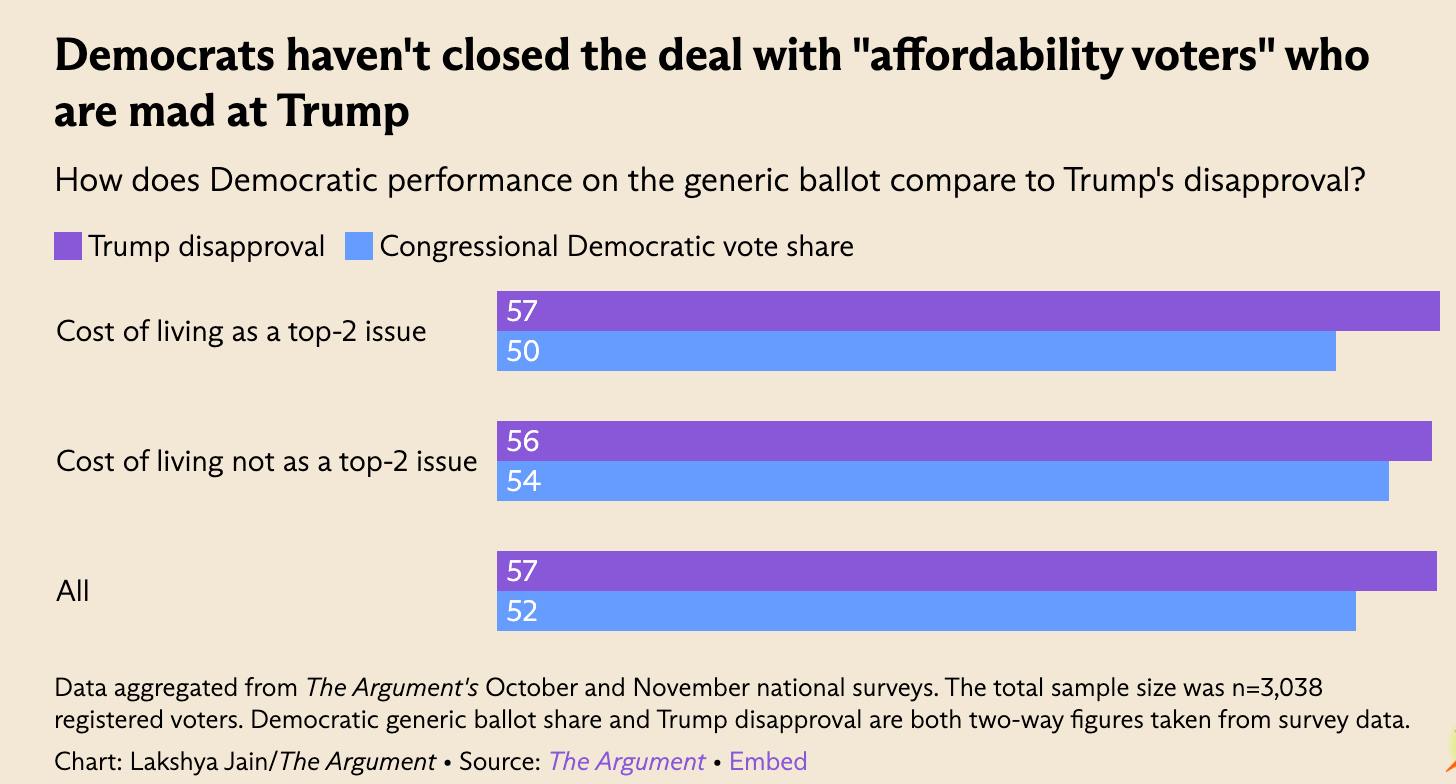
Image Credit: The Argument
A majority of voters disapprove of Trump’s performance on the economy, and that disapproval is especially strong among people who say the cost of living is a top concern. But here’s the problem: Democrats still haven’t converted that frustration into a supermajority of trust, even among voters who rank cost of living as a top-two issue. In other words, many voters are mad at Trump, but they’re not yet convinced Democrats will actually make their lives more affordable. Heading into 2026, closing that gap has to be the party’s central task: not just opposing Trump’s economic record, but clearly, relentlessly demonstrating how Democratic policies will lower prices and raise living standards.
Resolution #2: Reorient Healthcare Policy Around Supply, Not Just Subsidies
Subsidizing demand without expanding supply raises costs and entrenches incumbents. Democrats should push aggressively to increase the number of doctors (by lifting residency caps and recognizing more foreign-trained physicians), expand scope-of-practice rules for nurses and pharmacists, repeal Certificate of Need laws, and scale telehealth. More providers, more competition, and more care options are the only durable path to lower healthcare costs.
Resolution #3: Be Willing to Admit Where Recent Democratic Governance Fell Short
Defending every decision of the Biden era undermines credibility with voters who feel squeezed and unheard. Student loan forgiveness is an obvious example: it was fiscally expensive and widely perceived as unfair by voters who didn’t attend college or paid off their loans. Democrats need to show they’ve learned from the past.
Resolution #4: Actually Help Families With Child Care and Basics
Trump loves to tout “family values,” but his policies in 2025 left many American families holding the bag. Take child care: the cost of child care remains exorbitant (over $13,000 per year on average for one toddler), yet the sector is still reeling from pandemic losses and worker shortages. Own the mantle of making parenting affordable. Democrats should develop a concrete plan to address child-care costs and other everyday expenses (like prescription drugs, school meals, and college tuition) that strain family budgets. And on childcare specifically, Democrats need to recognize that subsidizing institutional daycare helps families where both parents work full-time (and that’s great), but many working-class families prefer home-based care, rely on relatives, or want a parent to stay home. They need help too. Cash benefits and flexible tax credits let families choose what works for them instead of implicitly pushing everyone toward the option when that may not be their preference.
Resolution #5: Champion All Kinds of New Housing Development
Dense urban infill and mixed-use, transit-oriented development are important — but the party can’t sound like it only cares about cities. Suburban housing matters too, and rural America needs better, cheaper options, including reforms like repealing the outdated chassis rule for manufactured homes. Bringing down housing costs means building more housing everywhere people want to live. That contrast matters, especially as Trump’s return to office has pushed costs in the wrong direction: his new tariffs on building materials like lumber, steel, and copper have added an estimated $17,500 to the cost of every new home, making an already brutal housing shortage even worse.
Resolution #6: Measure Success by Costs Going Down, Not Bills Passed
For too long, Democrats have treated legislative output as a proxy for economic success. But voters don’t experience laws — they experience rent checks, utility bills, insurance premiums, and child-care invoices. In 2026, Democrats should judge themselves the way voters do: are the costs that define everyday life actually going down, or at least growing more slowly? That doesn’t mean every price can be controlled overnight, or that the government has a magic inflation switch. It does mean prioritizing policies that change market dynamics — increasing supply, boosting competition, cutting bottlenecks, and enforcing rules — rather than celebrating bills whose benefits are distant, indirect, or invisible. If Democrats can’t clearly explain how a policy lowers rent, reduces medical bills, or shrinks monthly expenses within a reasonable timeframe, voters won’t credit them for it, no matter how impressive the legislative accomplishment sounds.
Resolution #7: Work With Labor — But Don’t Let Any Single Interest Group Veto Affordability
Labor unions are a core part of the Democratic coalition and often play a critical role in raising wages, improving job quality, and strengthening the middle class. When unions help deliver higher pay, safer workplaces, and more stable jobs without raising costs for everyone else, Democrats should champion that loudly. But unions, like any organized interest, represent workers in specific industries, not the broader public that ultimately pays higher prices when restrictive rules limit housing, transportation, healthcare, or service supply. A party serious about affordability has to strike a balance: defending worker protections while being honest when insider vetoes block reforms that would lower costs for families.
Resolution #8: Treat Occupational Licensing Reform as Core Economic Policy
Licensing barriers inflate costs across healthcare, childcare, construction, and personal services, while doing little to protect consumers. Reforming them is both pro-worker and pro-consumer — expanding access to jobs while lowering prices. Democrats should pursue this with the same urgency they bring to minimum wage policy.
Resolution #9: Take Energy Affordability Seriously — With Real “All-of-the-Above” Policy
Domestic energy production plays a real role in keeping prices down. Being reflexively hostile to oil and gas may satisfy activists, but it alienates voters in energy-producing states and hands Republicans an easy cost-of-living argument when gas prices spike. Democrats should pursue climate goals in ways that don’t sacrifice affordability or ignore economic realities.
But here’s the flip side: clean energy is now the cheapest energy. Wind and solar have become the lowest-cost sources of new electricity generation, often beating fossil fuels on price even without subsidies. Yet the Trump administration is actively capping renewable deployment through permitting restrictions — while claiming to care about affordability. Democrats should fight for permitting reform that accelerates all energy development, including wind and solar. Anyone blocking cheap clean energy is blocking affordable energy.
Resolution #10: Refocus Antitrust Around the Consumer Welfare Standard
Both extremes are wrong: Trump’s politicized, retaliatory antitrust and a posture that treats size itself as the enemy regardless of price effects. Democrats should return to a consumer welfare framework that prioritizes lower prices, higher output, and real competition — the standard that guided antitrust policy from Carter through Obama.
Resolution #11: Lean Into Nuclear Energy as a Cost-of-Living Solution
Nuclear provides stable, zero-emissions baseload power — exactly what’s needed for cheap, reliable electricity. If Democrats are serious about decarbonization and affordability, nuclear has to be part of the answer. Letting anti-nuclear sentiment veto the most practical clean-energy option is a luxury voters paying high utility bills can’t afford.
Resolution #12: Win by Running Candidates Who Actually Reflect the Voters They Want to Represent
Democrats don’t build durable majorities by narrowing the tent; they build them by expanding it. That means recruiting and supporting candidates who look, sound, and live like the communities they’re running to serve, especially in places Democrats have written off as unwinnable. Candidates don’t need to abandon core Democratic values, but they do need the freedom and credibility to speak to local concerns, local costs, and local culture without fear of ideological backlash. A party that insists on uniformity will keep losing winnable seats; a party that trusts its candidates to represent their constituents can build a true big tent — and win where few thought it was possible.
Conclusion
In 2026 Democrats need to become the party that actually delivers on affordability. Trump’s second term has already proven he can’t keep his promises on costs — tariffs are raising prices, chaos is paralyzing government, and working families are still struggling. But voter frustration with Trump won’t automatically translate into Democratic victories. Democrats have to earn that trust by relentlessly focusing on policies that lower the costs Americans face every day, from housing and healthcare to energy and childcare. That means embracing supply-side solutions, admitting past mistakes, and running candidates who genuinely connect with their communities.
Thank you to our subscribers who have been following along this past year! We are off for the rest of the year and look forward to seeing you back in the New Year!
-Tahra and Gary
Really strong framing on the childcare piece. The point about cash benefits versus institutional daycare subsidies matters way more than most policy debates acknowledge. I remember when a family friend had to quit a decent job becuase subsidized slots only covered 9-5 and her shift started at 6am, so the "help" was basically useless. Flexibility isnt just good policy, it's the differnce between whether support actually reaches people or just checks a box.
Thank you to both of you for all you’ve written this year. I’ve learned a lot and have cited The Rebuild in my own writings. I look forward to reading a lot more great stuff next year.